“Open the door”
See if this article by Dr. Mulholland doesn’t stir your heart to a greater desire to open the door to your Beloved . . .
Get Back to Where You Once Belonged
Open the Door
Atchison, Kansas, March 04, 2014 Dr. Edward Mulholland |
The Holy Spirit doesn’t fight fair. He hits you when you let your guard down. I was preparing for my Introduction to Hispanic Literature class, minding my own business. And I got triple teamed by the Holy Spirit, Lope de Vega and Longfellow.
One of the most famous sonnets in Spanish literature is ¿Qué tengo yo que mi amistad procuras? By the incomparable Lope Félix de Vega Carpio (1562-1635). An excellent anthology of Spanish verse online, prepared by Benedictine College alum Fred Jehle, professor emeritus at Indiana University-Purdue University Fort Wayne, includes a translation by none other than Henry Wadsworth Longfellow. A distant memory recalled that Longfellow had learned Spanish and translated Spanish poets. I decided to try my hand at making Lope’s lines ring true for the modern reader.
Lope himself is an amazing figure. A first class womanizer, Spanish Armada survivor, secretary to the Duke of Alba, he was ordained to the priesthood later in life to try to stave off temptations of the flesh. It only compounded his sin and guilt. But he was a prolific poet and dramatist, penning a few dozen volumes of verse and more than 400 plays. He was a tortured soul, and describes better than most the torture of a soul who perceives God’s call but struggles against the undertow of his own sins, original and actual.
Here’s my version of his sonnet:
What have I that You care to be my friend?
What interest could You possibly pursue,
That at my doorstep, Jesus, drenched with dew
The dismal nights of wintertime You spend?
My insides must be slabs of pure concrete;
I opened not for You! A monstrous thing,
If my ingratitude’s raw, icy sting
Dried out the wounds of your most holy feet!
How many times my angel did proclaim:
“Look out the window now, oh soul, and see
How He persists to call with love aflame”!
And, oh, how many, Beauteous Majesty,
“Tomorrow we will open” I would claim
To have my words the same tomorrow be!
While reading and re-reading it, it felt like it was my story, too. Perhaps less dramatic, but no less real. How often I screen God’s calls, and replay the voicemail, and leave Him hanging.
I had been postponing confession. After finishing with Lope, I took the hint and promptly got shriven. I may keep Lope’s poem handy to shame myself into answering my Guardian Angel, whose voice has recently gone hoarse.
The liturgy of Ash Wednesday is a clarion call to bust out of the listless lethargy of a mediocre lifestyle. God has destined us, in his Son, to glory. And to follow Him to glory we must follow Him to the cross. If we have strayed from the path, we must get back. We must, as the Beatles once sang, “get back to where we once belonged.” And there is no other belonging like that belonging, that warm embrace of my Creator, my Father, the One in whom I live and move and have my being.
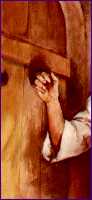 Lent is not about sacrifice for its own sake. It’s about opening doors. It’s about trimming away what separates me from God and makes me deaf to his voice. His is Beauteous Majesty. And I seek out fleeting fancy that is ugliness and subject myself to rulers unworthy of my rational soul.
Knock, knock. Who’s there? Jesus Christ, wounded out of love for you, chilled with ingratitude, shivering at your door. Don’t stand there saying “Jesus Christ, who?” Open the door.
“His answer changed my life.”
I’m reposting this because I’m reading this book again and this section had the same impact on me today as it did three years ago: to live trust is by praise and thanksgiving. Still learning . . .

As some of you know, I recently gave a talk at Witnesses to Hope on undoing the sin of Eve by deciding to trust in God’s goodness. At the end of the talk I shared about what the Lord had been teaching me about the importance of thanking Him in all circumstances. This morning I was reading from Consoling the Heart of Jesus, a Do-It-Yourself Retreat by Fr. Michael Gaitley. Fr. Michael was describing a conversation he had had with an older priest about trusting in Jesus. I was so encouraged to read this conclusion to the conversation:
[The older priest asked:] “And how do you live trust? What’s its concrete expression in your daily living?”
I was stumped, “I don’t know.”
His answer changed my life: “The way you live trust is by praise and thanksgiving, to praise and thank God in all things. That’s what the Lord said…
View original post 43 more words
The musician
from the archives . . .
A story from St. Francis de Sales that I call to mind when prayer gets “tough”:
One of the world’s finest musicians, who played the lute to perfection, in a brief time became so extremely deaf that he completely lost the use of his hearing. However, in spite of that he did not give up singing and playing the lute, doing so with marvelous delicacy by reason of his great skill which his deafness had not taken away. he had no pleasure either in singing or in the sound of the lute, since after his loss of hearing he could not perceive their sweetness and beauty. Hence he no longer sang or played except to entertain a prince whose native subject he was and whom he had a great inclination as well as an infinite obligation to please since he had been brought up from his youth in the prince’s…

View original post 138 more words
Some things I have learned to do
Reblogged from Mary Ann Morgan:
It was one of those days. I never saw the ledge, but I surely stepped off and fell right into the darkness. I am surprised by these dark days and I am grateful that they are more the exception and not the rule anymore. For a brief period of my life, they were my normal. For a season — an awful season — I found myself swirling, spiraling into the blackness every day.
If this is something you know well, I am so sorry. Here are some things I have learned to do when these days come.
1. Rest. Sometimes I just need to pull back from the stresses of life and rest. Giving myself permission to take a nap or a walk instead of working incessantly can do wonders for me.
2. Remember. This is just a day. This will not last forever. I remember God’s goodness in my life and ask for his perspective. Mine is obviously skewed and I need to know things from his point of view. Counting gifts does wonders for the heart.
3. Reach out. When I am feeling this way, the last thing I want to do is reach out to my friends. I don’t know why we are like this. Maybe pride? Fear? I have to remind myself of the times others have reached out to me in need and how it endeared them to me. We love to help others. Why would I deny someone the joy of being my friend when I need them?
It’s days like this I miss my daddy most. I just want to call him and hear his voice again. “Hey Mary Babe” he would always say. He was always so glad to hear my voice. I loved chatting with him about the flowers. He was a gardener and we shared a love for planting things. He would always tell me what was coming up in his yard. The tulips I planted for him are coming up around my birdhouse now. I just want to tell him about them, “Dad, I planted Tulips for you. They are red, your favorite color.”
I miss my dad, and it’s okay to cry about it. I think I can finally do that.
If you have had a hard day, or a bad week, my heart aches for you. I think we go through things sometimes just so we can be a better friend to others. Compassion sews threads of kindness into the lives of others. We cannot have it if we have not experienced pain of some sort in our own lives. Know this: God is with you and he loves you dearly. He is present with you and he will give you just what you need. You are not alone. Ever.
Psalm 34:4-7 ~
“I prayed to the Lord, and he answered me.
He freed me from all my fears.
Those who look to him for help will be radiant with joy;
no shadow of shame will darken their faces.
In my desperation I prayed, and the Lord listened;
he saved me from all my troubles.
For the angel of the Lord is a guard;
he surrounds and defends all who fear him.”
When the thread snaps
If you feel things are out of control in your life (and even if you don’t), this is for you:
Hanging By A Thread
A week ago, I thought I had things under control. My blog post was up on Monday and I’d jotted down thoughts for another two; my upcoming classes with senior executives were planned; my beard was trimmed.
On Tuesday, I ate lunch with a friend I’ve been out of contact with for a while. He gave me inscribed copies of his two most recent books, which I started reading that day. Then, it all changed.
We brought our eight year old, Jopa, to the MD’s office that afternoon. She’d been showing signs of what we thought was an infection. We were wrong. It was Type I diabetes.
One day her pancreas was producing insulin. The next it was not. Her life, and ours, changed forever with the mysterious shutting down of her relevant cells.
She and my wife went to the hospital, where they remained for three days. And, that was the least of it. She’ll be pinpricking her finger and giving herself shots for as long as she lives.
Something similar happened to a parishioner who was healthy and living a normal life on Friday. Saturday, he slipped on the ubiquitous ice, cracked his skull, and underwent emergency brain surgery. He is in critical condition, fighting for his life.
Read the rest here.
Lord Jesus, Who Would Think
Lord Jesus, Who Would Think That I Am Thine?
Lord Jesus, who would think that I am Thine?
Ah, who would think
Who sees me ready to turn back or sink,
That Thou art mine?
I cannot hold Thee fast though Thou art mine:
Hold Thou me fast,
So earth shall know at last and heaven at last
That I am Thine.
Christina Georgina Rossetti
Someone else’s hindsight
Sometimes someone else’s hindsight can help us to have a better attitude at the trials in our own lives. Listen to what Scott Hamilton shares about the trials in his life:
Trials of trust
This is for you who are going through times of great darkness and/or suffering:
“Hope and trust grow and increase only by trial, suffering, danger, sorrow, and even if it comes, horror. For this reason, darkness is an essential part of the spiritual journey–darkness of many kinds.”
“Some have called this trust the greatest act of worship we can perform, because it unites us in a more realistic way with the mystery of Christ.” (Fr. Benedict Groeschel)
I thank all of you, on behalf of the Church, all of you who are offering the trials, dangers, even horrors to God as an act of worship. May God sustain you and give you hope.
To look at Him who is looking at you
A fascinating way of looking at holiness, and not necessarily an easy one:
Holiness consists in enduring God’s glance. It may appear mere passivity to withstand the look of an eye; but everyone knows how much exertion is required when this occurs in an essential encounter. Our glances mostly brush by each other indirectly, or they turn quickly away, or they give themselves not personally but only socially. So too do we constantly flee form God into a distance that is theoretical, rhetorical, sentimental, aesthetic, or most frequently, pious. Or we flee from him to external works. And yet, the best thing would be to surrender one’s naked heart to the fire of this all–penetrating glance. The heart would then itself have to catch fire, if it were not always artificially dispersing the rays that come to it as through a magnifying glass. Such  enduring would be the opposite of a Stoic’s hardening his face: it would be yielding, declaring oneself beaten, capitulating, entrusting oneself, casting oneself into him. It would be childlike loving, since for children the glance of the father is not painful: with wide-open eyes they look into his. Little Thérèse–great little Thérèse–could do it. Augustine’s formula on the essence of eternity: videntem videre–‘to look at him who is looking at you.’ (Hans Urs Von Balthasar, The Grain of Wheat)
 Witnesses to Hope