Words fail me tonight, O Lord,
But wrapped in silence,
My heart speaks its adoration with every beat
As my gaze meets yours
And I’m held captive within that single glance.
Jeanne Kun
Words fail me tonight, O Lord,
But wrapped in silence,
My heart speaks its adoration with every beat
As my gaze meets yours
And I’m held captive within that single glance.
Jeanne Kun
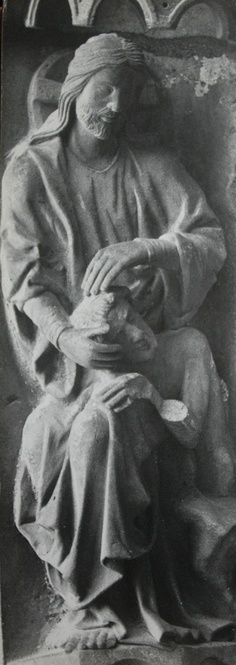
“Christ & Adam at Chartres. This is a stone carving over the north porch of the cathedral of Our Lady at Chartres, so small and among so many other carvings one has to look carefully to see it. It is for me one of the most powerful religious images I know of. Creation as an act of love. Adam (and thus all of us) bearers of God’s image.” (Jim Forest)
This was written by a friend of mine, Chris de Vinck. (see “The Power of the Powerless”) He’s a great storyteller and whatever he writes is worth reading.
What is Your Name?
What is your name, so that we may honor you when your word comes true? (Judges 13.17)
I heard a story about Berry. I do not know why she was called Berry, but this is what I heard about her. She was born in a trailer in South Dakota. Her father was a locksmith, and her mother worked in the post office.
After a terrible fire in the trailer, both the father and the mother perished. Berry sustained burns over eithgy percent of her body, was blinded for life, and become morose and unhappy.
Berry never married. She attended school up to the tenth grade, then she was taken north by her aunt, who had a flower business in New York State.
Berry spent many days in the florist shop, answering phones and dictating orders on a tape recorder that her aunt played back whenever she was able to catch up on business.
The children int he neighborhood teased Berry by calling her names such as “Alligator Lady,” or “Goofy Eyes.” At first these things hurt the young woman; then, one day, Berry just laughed and asked the children what their names were.
The local children soon became enchanted with this Miss Berry who laughed and knew the smell of every flower they brought her. One boy, who was particularly shy, fetched Miss Berry’s mail each day and read it to her.
Miss Berry learned braille, wrote letters to the newspaper about the pollution she smelled while sitting out back where the maple tree grew. And to the boy who brought the mail she began to read stories about pirates, airplanes, and secret spies who rescued people from terrible fates by hiding them in the mountains of Europe.
Miss Berry stayed with her aunt until the aunt died. She attended college, received her degree in law, and became a public defender for abused children.
When Miss Berry died, she had no family. A young man from the old neighborhood read int he papers that Miss Berry had died, so he went over and said that he would like to make a contribution.
Before she died, the only thing that Miss Berry didn’t tend to herself was a headstone, so the young man paid for the headstone. When he was asked what he would like to have engraved on the stone, he thought for some time, then wrote a few words on a piece of paper and handed it to the stonecutter.
The stonecutter read the words and smiled: “I also knew her. These words will suit her just fine: Miss Berry: She Loved All the Flowers and All the Children.”
When we human beings are confronted with something we do not understand, we become suspicious, just as the children were when they first met Miss Berry. We need to have answers. We need to know. And if we do not understand something, as the children didn’t at first understand Miss Berry, we become afraid, or we make jokes, or we push for answers.
During the time of Christ, people were puzzled about a man who was baptizing. They wanted to know if he was Jesus. John the Baptist confessed freely, “I am not the Christ.”
They asked him, “Then who are you? Are you Elijah?”
He said, “I am not.”
“Are you the Prophet?”
He answered, “No.”
Finally they said, “Who are you? Give us an answer to take back to those who sent us. What do you say about yourself?”
John replied in the words of Isaiah the prophet, “I am the voice of one calling int he desert, ‘Make straight the way of the Lord'” (John 1.20-23).
One of the most significant things we can do is answer to God, “What do you say about yourself?”
I think Miss Berry would simply laugh and say, “Well, the children call me Alligator Woman; I became a lawyer; I like flowers; and there was a boy who read my mail to me each day for eight years. I learned to read because of him.”
Who we are is connected to those we love and to those who have influenced us toward goodness. John the Baptist loved Jesus and was influenced by His words. John was never the same because of Jesus’ spiritual intervention.
The small boy who read to Miss Berry intervened in her spirit, and she was no longer the same person because of the child’s kindness.
We all have the potential to be the one who baptizes. We all have the potential to be moved to action. Today let us make straight the way of the Lord.
“Meeting the Lord [is important], but more importantly, let us be met by the Lord: this is a grace.” (Pope Francis)
May you perceive His meeting you today in this ordinary time of life.
Friday: from the archives

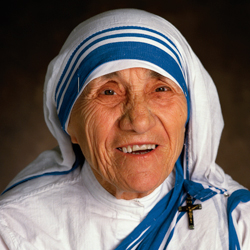 “Once a successful businessman went to work in one of Mother Teresa’s shelters for the poor in India. His frustration at not finding the little woman there was overturned on the day before his departure when she returned. He was moved to tears of joyous surprise when, on admitting that his whole life was self-concerned, instead of being like hers, she held his shoulders and looked deep into his eyes saying: ‘Know that God appreciates you are doing the best you can.'”
And He says the same to you today: “Know that God appreciates you are doing the best you can.”

“There is nothing so perfect in the world as to be quite above objection and criticism. The very sun which gives us light and warmth is not free from spots, yet notwithstanding these defects it does not desist from its regular duty. It behoves us in like manner to carry on to the best of our ability what has been entrusted to us . . .” (Sundar Singh)

In the matter of
God’s goodness
we have got to be
irrational.
This is the way it is,
with love, for instance,
and with any other
deep down, visceral persuasion.
We go beyond reason,
we do not trust
appearances.
All surface indications
to the contrary
we have got to believe that
God is good,
unfailingly good to us.
Even in the thick
of troubles,
in moments of dire tragedy,
calamity,
disaster,
God is being good.
This is illogical,
it is nonsense
but it is true.
His goodness
is never
one whit diminished,
obscured
or blunted.
Monsignor James Turro

 Witnesses to Hope