Before I close my eyes

A Sunday poem by Franki.

Before I close my eyes
I exhale
As if having
held my breath
since waking.

A whisper
reminds me of a
humble man, 
whose sandals
I’m not
worthy to untie.

Whose beauty
I’m not 
worthy to behold,
whose beard
I’m not
worthy to kiss,
whose hands
I’m not
worthy to hold,
His hands
I’m still
trying to hold.

Before I close my eyes
I breathe in,
as if having
received life
from the one
who made me.

Who invites me to
break bread
at his table,
where stones
lay lost
around us.

Before I close m eyes
he looks
into mine
(inhales)
and
calls me
beloved
(exhales).

Under his gentle hand

I have always been drawn to this sculpture but did not discover its origin until today. And that happened by reading an entry in Raissa’s Journal in which she describes a sculpture from Chartres. When I searched for the sculpture, I found it to be this very one which I myself have meditated on for years. It is of Christ and the creation of Adam. I have found such tenderness in it all these years. Raissa’s comments:

“Looking at the photograph of a sculpture in Chartres Cathedral, God moulding Adam, drawn to recollection by the thought that our very loving Father continues to mould us like that right up to the day when our perfection is achieved in Heaven.
“Ah! to stay like that under his gentle hand, one’s head abandoned on his maternal lap and let him do as he will with one, always.”
(Saturday, 14th April)

Her comments will make my meditation on this so much richer for years to come.

Book Notes 2

Today’s book quote comes from Romano Guardini’s The Living God.

“There is nothing brighter than the eyes of God, nor is there anything more comforting. They are unyielding, but they are the source of hope. 
      “To be seen by him does not mean to be exposed to a merciless gaze, but to be enfolded in the deepest care. Human seeing often destroys the mystery of the other. God seeing creates it.
      “We can do nothing better than to press on into the sight of God. The more deeply we understand what God is, the more fervently we shall want to be seen by him. We are seen by him whether we want to be or not. The difference is whether we try to elude his sight, or strive to enter it, understanding the meaning of his gaze, coming to terms with it, and desiring that his will be done.
     “We can do nothing more better then place ourselves and all that we have in God’s sight: ‘Behold me! Let us put away the fear that prevents us. Let us abandon this sloth, the pretense of Independence, and the pride. ‘Look at the good! Look at the shortcomings! The ugly, the unjust the evil, the wicked, everything–look at it, O God!’
     “Sometimes it is impossible to alter something or another. But let him see it at any rate. Sometimes one cannot honestly repent. But let him see that we cannot yet repent. None of the shortcomings and evil in our lives are fatal as long as they confront his gaze. The very act of placing ourselves in his sight is the beginning of renewal. Everything is possible so long as we begin with God. But everything is in danger once we refuse to place ourselves and our lives in his sight.”

Book notes 1

I love to collect quotes. In fact, I am known for it in our community. So I thought I would start a series sharing some of those with you. This first batch is from a book by Frederica Matthewes-Green called The Jesus Prayer which I read almost 15 years ago.

“So practice agape [long suffering, self-giving love] in every context (and it does take lots of practice). Every person you encounter gives you a God-appointed opportunity to die to self. The six or ten people you deal with every day are meant to furnish your own Roman Colosseum where you can battle against self-will to your last breath.” (p.51)

“Expect that you will have sorrow, and that you will suffer injustice; expect this, and it won’t shatter your faith. Believe firmly that all your joy is with Christ, and you will be able to bear it if other sources of joy prove temporary, or are never found at all.” (p. 52)

“Humility is of more value than the greatest asceticism. One day, as the desert monk Saint Macarius was returning to his cell, the devil attacked him swinging a scythe, but was unable to wound him. The devil complained, ‘Macarius, I suffer a lot of violence from you for I cannot overcome you. Whatever you do, I do also. If you fast, I eat nothing; if you keep watch, I never sleep. There is only one way in which you surpass me: your humility. That is why I cannot prevail against you.'” (p. 53)

Unconditional poverty

That phrase has been haunting my thoughts the past couple of weeks. It comes from a passage which I will quote in a bit. I have been familiar for a long time with the concept of standing before the Lord in one’s poverty. Learning to do so is not an easy thing. I find myself so often choosing what bits of my poverty to bring to him and hiding others. I’ll come to him with my inability to love my sisters very well, but I’ll hide my failings with keeping my time on social media under control. The temptation is always to hide what causes me the most shame. So I was really struck by this description of “unconditional poverty” because that means that I must stand before the Lord in all of my poverty, every bit and expression of my lack and my failings. But I know that is the only way for me to be open to all of his love for me and not just part. The times when I have responded to the grace to be completely vulnerable to him, hiding nothing, have been the most intimate. So, I pray that that phrase haunt me for ever, for I know I will never have what I most desire–which is his very Self–without unconditional poverty being my continual and habitual state of being before him. Pray for me for that.

“All that I am, all that I have ever felt, known, had, or desired–all shame and fear, all desire and effort, all failure and guilt, all capacities and incapacities, all experience and expectation–everything absolutely everything, is to be laid before him in trusting nakedness, and to be opened wide, in unconditional poverty, to receive his gift as he wishes to give it and this gift is ultimately his very Self . . . .” (Joshua Elzner, Responding to the Thirst of God)

Be His still-remaining

How a poem about our Lady on this Mother’s Day? This is a poem I have posted before. It’s also about the Ascension, about her experience after Jesus ascended. Seems doubly appropriate for today.

Our Lady of the Assumption

Fold your love like hands around the moment.
Keep it for conference with your heart, that exit
Caught on clocks, by dutiful scribes recorded
Less truly than in archives of yor soul.

Turn back from His going, be His still-remaining.
Lift the familiar latch on cottage door . . .
Discover His voice in corners, hear His footfalls
Run down the porches of your thoughts.  No powers

However hoarse with joy, no Dominations
Curved with adoration guess what whispers
Of “Mother, look!” and “Mother, hurry!”
Glance off the cottage walls in shafts of glory.

How shall your heart keep swinging longer, Mary?
Quickly, quickly, take the sturdy needle
Before your soul crowds through your flesh!  the needle
And stout black thread will save you.  Take the sandal

Peter left for mending.  After that,
The time is short, with bread to bake for John.

Mother Mary Francis

May the blessings

For any and all being ordained to the priesthood this spring. A Sunday-poem by John O’Donohue, a priest himself.

May the blessings released through your hands
Cause windows to open in darkened minds.

May the sufferings your calling brings
Be but winter before the spring.

May the companionship of your doubt
Restore what your beliefs leave out.

May the secret hungers of your heart
Harvest from emptiness its sacred fruit.

May your solitude be a voyage
Into the wilderness and wonder of God.

May your words have the prophetic edge
To enable the heart to hear itself.

May the silence where your calling dwells
Foster your freedom in all you do and feel.

May you find words full of divine warmth
To clothe the dying in the language of dawn.

May the slow light of the Eucharist
Be a sure shelter around your future.

And I would add: May you always find your home deep, deep in the Heart of Christ and never venture from there. 

pic08_JPG

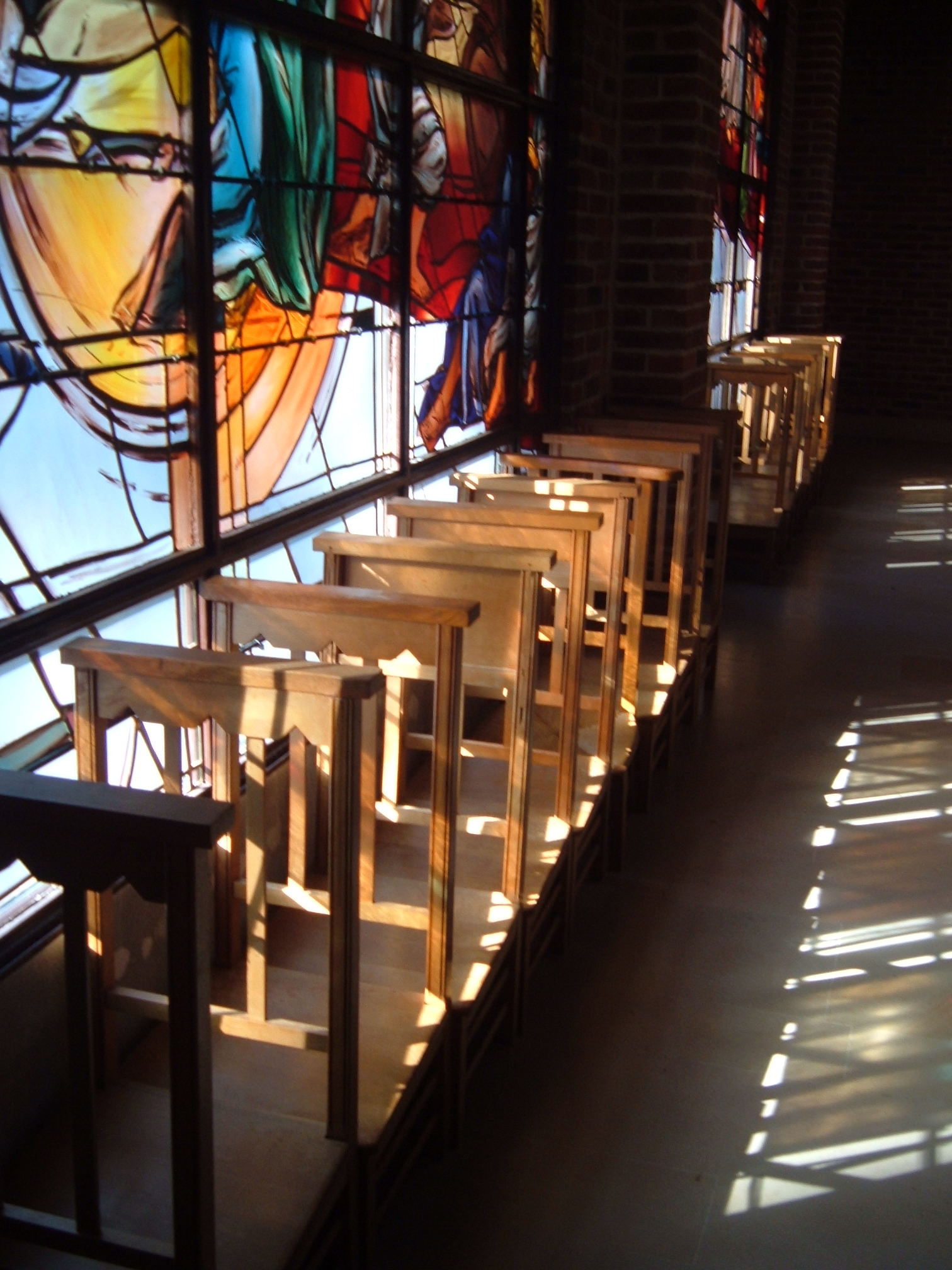
In an empty church

A beautiful short Sunday-poem. Using just a few words, Joseph Massey creates an exquisite image of prayer in an empty church. Do sit with it for a moment.

       In an empty church
in the middle of the day
dark but for stained glass
       flooded with sun, a prayer
held in the breath in my hands. 


You can find his latest bestselling book of poems here

I wish for a hidden hut

An anonymous lovely, lilting poem from Sally Read’s 100 Great Catholic Poems that describes the longing of many of our hearts.

The Song of Manchán the Hermit

I wish, O Son of the Living God, O Ancient Eternal King,
For a hidden hut in the wilderness, a simple secluded thing.

The all-blithe lithe little lark in his place, chanting his lightsome lay;
The calm, clear pool of the Spirit’s grace, washing m sins away.

A wide, wild woodland on every side, its shades the nursery
Of glad-voiced songsters, who at day-dawn chant their sweet psalm for me.

A southern aspect to catch the sun, a brook across the floor,
A choice land, rich with gracious gifts, down-stretching from my door.

Few men and wise, these would I prize, men of content and power,
To raise Thy praise throughout the days at each canonical hour.

Four times three, three times four, fitted for every need,
To the King of the Sun praying each one, this were a grace, indeed.

Twelve in the church to chant the hours, kneeling there twain and twain;
And I before, near the chancel door, listening their low refrain.

A pleasant church with an Altar-cloth, where Christ sits at the board,
And a shining candle shedding its ray on the white words of the Lord.

Brief meals between, when prayer is done, our modest needs supply;
No greed in our share of the simple fare, no boasting or ribaldry.

This is the husbandry I choose, laborious, simple, free,
The fragrant leek about my door, the hen and the humble bee.

Rough raiment of tweed, enough for my need, this will my King allow;
And I to be sitting praying to God under every leafy bough.