The man Pope Francis kissed is all of us

Reblogging from Elizabeth Scalia:

“I am not contagious”: Vinicio Riva on Francis’ Kiss

November 18, 2013 By  

Everyone remembers this gentleman, and this beautiful moment, one that has lingered in our awareness so well that weeks later, we are still reading, writing and talking about it,still processing it:

When these pictures burst upon the scene, Max Lindenman, in a thoughtful post, wondered (worried?) whether the man’s anonymity might tempt us to dismiss his human reality.

But I do wish I knew more about him — his name, his nationality, his employment history, how faith and doubt play out in his life, any detail that tends to mark him as an individual. Through no fault of his own, he comes off in its absence like a prop, a flat character in a story called How Francis Transformed the Papacy.

In the story, his purpose, his job, is to be merely pitiable — or worse. The Kindness Blog’s headline refers to him as “Horribly Disfigured Man”; to UCatholic, he’s “Severely Disfigured Man.” Vatican Insider’s copy is a little more delicate, bumping up his status to “man plagued with neurofibromatosis.” But the line following the photo — “Pope Francis’ humanity shone [sic] through once again as he kissed a man’s disfigured face” — gives the game away. And it’s the same old game. We’re meant to understand that nobody but a saint would touch the guy with a ten-foot pole.

Finally, we know his name, and it all becomes even more real.

Vinicio Riva, whose head and neck are covered with tumors due to a rare disease, told an Italian magazine that his disfigured appearance has led to a lifetime of living on the margins. […]

Riva, who lives in Vicenza in northern Italy, said he suffers from neurofibromatosis Type 1, which causes painful tumors to grow throughout his body. His younger sisters and late mother also suffered from the rare disease, Riva told Panorama.

The first signs of the disease began when he was 15, Riva said, and since then, he has often felt ostracized because of his unusual appearance.

But the Pope showed no sign of discomfort as he approached, said Riva. Instead, the pontiff’s face broke into a calm smile.

“But what most astonished me is that he didn’t think twice on embracing me,” Riva said. “I’m not contagious, but he didn’t know. He just did it; he caressed all my face, and while he was doing that, I felt only love.”

Vinicio Riva has been marginalized for much of his life, because of his appearance; now he is celebrated and made known. In one of those great paradoxes of faith, the very malady that had pushed him to the edges of society was the thing that brought him into contact with the great, unnerving, liberating mystery that is love unnarrowed and unleashed, and all in the sight of the whole world.

Rather than instinctively looking away from Vinicio Riva; we now can’t take our eyes off of him, so fascinated are we by the revelation of love’s awe-full beauty, and the way it renders adorable what had previously seemed unlovable. Though we are afraid, we want it, too.

Pondering of all of this in the light of our broken, disfigured souls, we may literally tremble. I know I do. As physically unattractive as I am, it is my interior ugliness that often makes me feel repellent — to myself, to God, to the world — and it is the greater weight I drag as I wander the peripheries and wonder how much love I dare lay claim to.

And yet. . .here is hope, even for one as damaged and ghastly as I, in all my dark sins. This moment between Francis and Vinicio is just a small revelation of the love we are promised in the light of Christ. If this tiny apocalypse of pure love has us entranced and moved, what might the whole glory of it be were we to permit an unrestricted Christ-kiss to our souls?

We can’t even imagine it without becoming a little breathless, and yes, overwhelmed. It is promised to us. Dare we believe that with our whole hearts, and let it draw us into revelation?

Vinicio Riva is not contagious, but I really hope the love unleashed in that stark moment in Saint Peter’s Square becomes a kind of viral contagion — one that makes us so “sick with love” that we are (again, in divine paradox) cleansed, healed and made whole; slower to reject others, and faster to respect them; tempering our own harsh sell-assessments with a prudent, not indulgent, measure of mercy.


“God sits on a chair of darkness in my soul.”

(This is a repost of a profound poem.)

The poem I have to share with you this Sunday is another by Jessica Powers:

The Garments of God

God sits on a chair of darkness in my soul.
He is God alone, supreme in His majesty.
I sit at His feet, a child in the dark beside Him;
my joy is aware of His glance and my sorrow is tempted
to nest on the thought that His face is turned from me.
He is clothed in the robes of His mercy, voluminous garments–
not velvet or silk and affable to the touch,
but fabric strong for a frantic hand to clutch,
and I hold to it fast with the fingers of my will.
Here is my cry of faith, my deep avowal
to the Divinity that I am but dust.
Here is the loud profession of my trust.
I need not go abroad
to the hills of speech or the hinterlands of music
for a crier to walk in my soul where all is still.
I have this potent prayer through good or ill:
here in the dark I clutch the garments of God.

In front of more weakness

Continuing from yesterday’s post:

Secondly, I would emphasize his gentleness with people, especially his mercy.  I have to say that the priest Bergoglio has a very great sense of mercy.  Bergoglio is capable of forgiving what one might not be able to forgive himself.  I have always said that whoever hits bottom, whoever it may be, in Bergoglio he will find shelter, and it continues to be like that today.  This is true for whoever it may be, from your best friend to your worst enemy.  In front of more weakness, Bergoglio works better, in a strange spiritual equation, so to speak.  So if I would have to single out only one thing that remains with me–even though I do not know if I practice it, I am nevertheless grateful for it–it is his sense of mercy.  Very few times have I seen mercy at the depths to which he lives it . . .

This slideshow requires JavaScript.

First to prayer

If you’re like me, you just want to read anything you can about Pope Francis.  I am currently reading Pope Francis, Our Brother, Our Friend: Personal Recollections about the Man Who Became Pope.  It is a collection of interviews with twenty people who are well acquainted with him.  This first selection is by Father Ángel Rossi.  Father Bergoglio was in charge of his formation during his years of studies.  Here is the beginning of his reflection:

What I always remember about the figure of Bergoglio is that he was a spiritual man, a man of prayer.  Bergoglio is a “pray-er:” a man who brings things first to prayer. Without wanting to go around measuring with a stopwatch, I would say that he prayed for at least three hours per day, and I’m sure he continues doing it because he is an early riser.  When we would get up at 6:30 or 7:00 to go to Mass, Bergoglio would have already prayed and already washed the sheets and towels for 150 Jesuits in the laundry room.  He would have already washed them and already hung them up when we were only just starting to get on our feet.

To be continued tomorrow . . . .

Terrible with Raisins

Something to think about . . .

barnstormingblog's avatarBarnstorming

woods23

woods20

woods16

This wasn’t just plain terrible,
this was fancy terrible.
This was terrible with raisins in it.
~Dorothy Parker

More and more of my clinic time is devoted to evaluation and treatment of depression and anxiety rather than sore throats, coughs, UTIs and sprains/strains.  An outbreak of overwhelming misery is climbing to epidemic proportions in our society.  A majority of the patients who are coming in for mental health assessment are at the point where their symptoms are interfering with nearly every aspect of their daily activities and they can no longer cope.  Their relationships are disintegrating, their work/school responsibilities are suffering, they are alarmingly self-medicating with alcohol, marijuana and pornography or whatever seems to give momentary relief.   Suicidal ideation has become common, almost normative, certainly no longer rare.

Things seem terrible.  And not just plain terrible.  First-world-problem-terrible with raisins in it.

We have lost all perspective about terrible.

Terrible…

View original post 315 more words

Six words

It is so easy to grumble, isn’t it?  Here’s a little encouragement from Amy Carmichael to choose another way of looking at your life:

Num 11.5: We remember the fish, which we did eat in Egypt freely; the cucumbers, and the melons, and the leeks, and the onions, and the garlic.

Ps 40.10 (BCP): I should fulfill Thy will, O my God: I am content to do it.

To think of nice things one can’t have is to become discontented and grumpy.  Is there something you want and can’t have today?  Are you tempted to grouse about it?  repeat that little string of six words to yourself quite slowly and solemnly: “Fish, cucumbers, melons, leeks, onions, garlic.”  If you haven’t time for all six just say, “Cucumbers,” and see what will happen.  First you will laugh.  Then in a flash you will remember those foolish and ungrateful people whose story you know so well.  You will remember, too, how patiently God bore with them; and you will be ashamed that even for one moment you joined forces with them.

We are all sure to be tempted by thoughts of fish, cucumbers, melons, onions, leeks, and garlic–things we would like but cannot have at present.  But there is another set of six words which is as happy as the first set of six is unhappy.  They were spoken by our Lord Jesus Christ about His Father’s will: I am content to do it.

Which set of six will you take for your own?  You can’t have both; they won’t mix.  So choose.

“He can’t stand losing one of His own.”

That translates: He can’t stand losing you.

Pope Francis: God has a loving weakness for the lost sheep

2013-11-07 Vatican Radio

(Vatican Radio) Finding the lost sheep is a joy to God, because he has a “loving weakness” for those who are lost. These were the words of Pope Francis during his homily at Mass on Thursday morning in Casa Santa Marta.
Commenting on the parables of the lost sheep and of the lost coin, Pope Francis talked about the attitude of the scribes and the Pharisees, who were scandalised by the things that Jesus did. They murmured against him: “This man is dangerous, he eats with the publicans and the sinners, he offends God, he desecrates the ministry of the prophet to accost these people”. Jesus, the Pope explained, says that this “is the music of hypocrisy”, and “answers this hypocrisy with a parable”.

“He replies to this murmuring with a joyful parable. The words ‘joy’ and ‘happiness’ appear in this short text four times: three times joy, and once happiness. “And you” – it’s as if he were saying – “you are scandalised by this, but my Father rejoices”. That is the most profound message of this story: the joy of God, a God who doesn’t like to lose. God is not a good loser, and this is why, in order not to lose, He goes out on his own, and He goes, He searches. He is a God who searches: He searches for all those who are far away from Him, like the shepherd who goes to search for the lost sheep.”

The work of God, the Pope continued, is to “go and search”, in order to “invite everyone to the celebrations, good and bad”.

“He can’t stand losing one of His own. And this is the prayer of Jesus, too, on Holy Thursday: “Father, may none get lost, of those You have given to me”. He is a God who walks around searching for us, and has a certain loving weakness for those who are furthest away, who are lost. He goes and searches for them. And how does he search? He searches until the end, like the shepherd who goes out into the darkness, searching, until he finds the sheep. Or like the woman, when she loses a coin, who lights a lamp and sweeps the house, and searches carefully. That’s how God searches. “I won’t lose this son, he’s mine! And I don’t want to lose him.” This is our Father: he always comes searching for us.”
Then, Pope Francis explained, “when he has found the sheep” and brought it back into the fold with the others, no one must say ‘you are lost’, but everyone should say ‘you are one of us’, because this returns dignity to the lost sheep. “There is no difference”, because God “returns to the fold everyone he finds. And when he does this, he is a God who rejoices”.

“The joy of God is not the death of the sinner, but the life of the sinner. And how far from this were those who murmured against Jesus, how far from the heart of God! They didn’t know Him. They thought that being religious, being good people meant always being well-mannered and polite, and often pretending to be polite, right? This is the hypocrisy of the murmuring. But the joy of God the Father, in fact, is love. He loves us. “But I’m a sinner, I’ve done this and that and the other!” “But I love you anyway, and I go out searching for you, and I bring you home.” This is our Father. Let’s reflect on this.”

“Stay with me, Lord.”

11022617009791ee2932f0e1f4

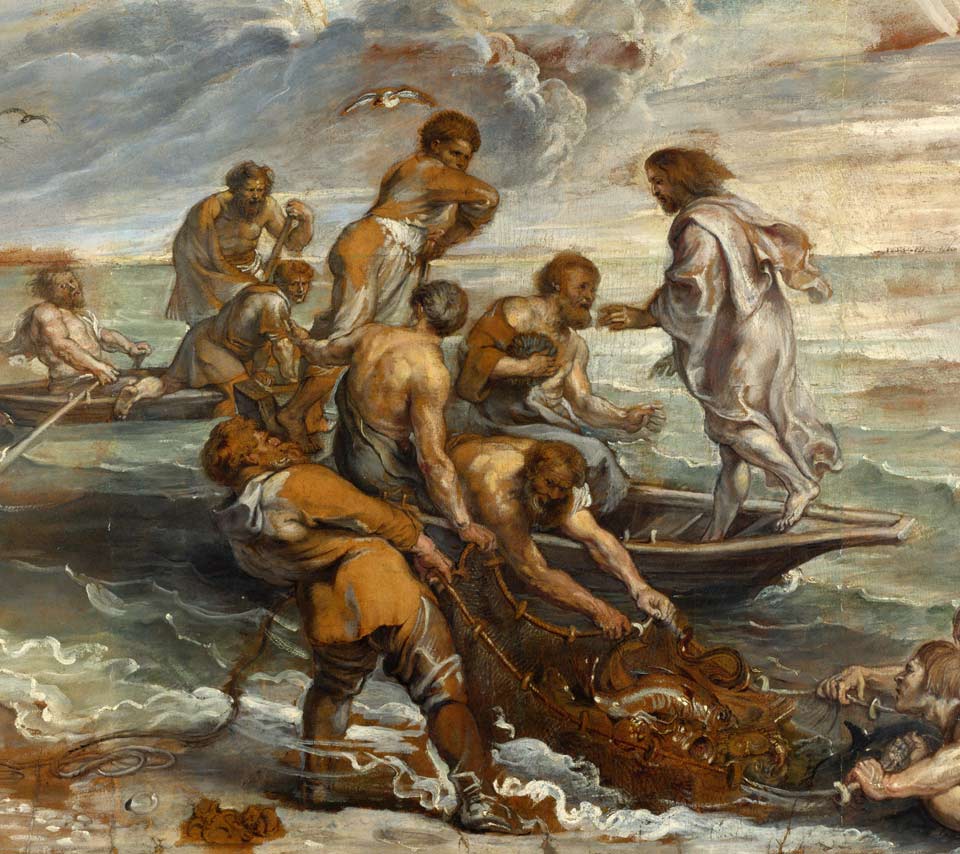
Simon’s heart was racing from effort and emotion, and he gasped for breath as he made his way through the fish to where Jesus was sitting in the stern.  Simon approached this man whose presence had become almost unbearable: they were too different, too distant, too “other.”  And yet it seemed to him that this presence was such an absolute gift to him that only Jesus could reestablish the correct distance between them.

Simon was overtaken by a sense of unworthiness: everything in his life that was petty, false, angry, silly, greedy proud, vile had now become a heavy, nauseating heap.

He was surprised himself by what he cried out in front of everyone: “Depart from me, for I am a sinful man, O Lord” (Lk 5.8).  And he knew that no truer words had ever come from his lips.

Even so, just as his words were disappearing into the noise of the water, the wind, the boat, Simon understood that these words, too, were false.  They were no longer true before that face, before the expression of Jesus, who continued to stare at him in silence.  The words were true inside of Peter himself, in his heart, in his humanity, but they were no longer true before Jesus.  He had not yet finished saying, “Depart from me, Lord,” when his heart began crying in desolation, “No! Stay with me, Lord!  Take me with you!”

~Dom Mauro Giuseppe Lepori, O. Cist.