The right kind of sympathy

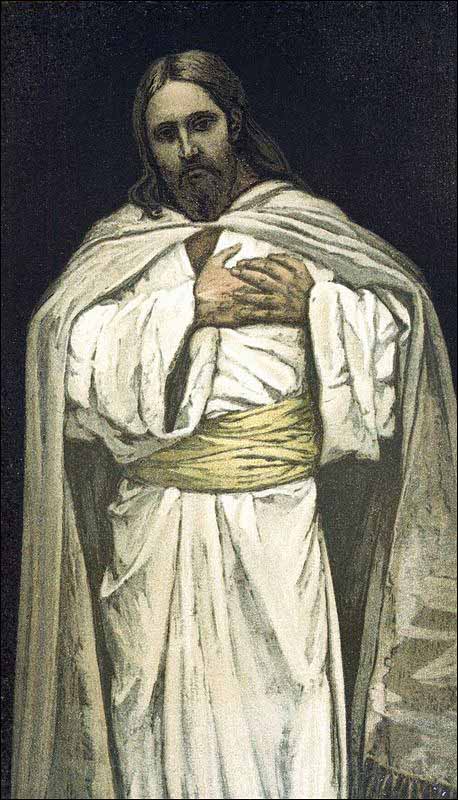
Matthew 26.38 Then he said to them, ‘My soul is very sorrowful, even to death; remain here, and watch with me.”

“Mary Mozley of Central Africa wrote in a letter: “Somebody suggested this thought to me, and it came home to me the other day in reading about Christ in Gethsemane–that the way to show true sympathy is not to pity, but to stand by and strengthen the sufferer to do God’s will.  And in Gethsemane, when Christ turned to the three for sympathy, it was with the words, ‘Watch with Me.’ ‘Stand by Me.’  He asked for no pity, but for the strengthening which might seem a feeble help, just that they might let their presence and prayer tell there for Him, to strengthen Him to do the will of God.”

“The Lord help each one of us to ‘stand by’ one another with just this kind of bracing sympathy.”

(Amy Carmichael)

A Prayer of Hope

A Prayer of Hope, Before the Blessed Sacrament

Within Your small circumference,
my Eucharistic Lord,
I see the world entire,
an image of the globe as You made it:
pure round planet
lovingly crafted,
playfully spinning,
laden with hope and promise.

Within Your shadow,
my Eucharistic Lord,
I see the world as well,
an image of the world as it became:
dark round abyss
hollowed out in rebellion,
yawning in malice,
swirling with rage and despair

But into the maw
of that black hole of sin
You have tossed this tiny Orb
of Your divinity.
The blackness swallows
but chokes:
Death must die.

For this humble Star has burst
into a glorious Supernova
filling the abyss,
slaying the darkness,
transfiguring the heaven
with the splendor of a billion suns.

Draw me in,
my Eucharistic Lord,
by Your gravity of goodness;
set ablaze, set me spinning
into orbit around You.
Lead me in Your radiant train,
a bright speck
in Your galaxy of grace.

~Paul Thigpen

To forgive

I just read this amazing story of love and forgiveness and want to share it with you:

For years he nourished only his narcissism: money, brand name clothes, perfumes, luxurious cars, parties, in short. a trivial evil. Then he was tempted to the point of folly: to kill his parents and acquire his inheritance. He tried to kill them first with gas bombs which should have exploded and would have also killed his two sisters. He then tried to tamper with his father’s steering wheel. He thought of using rat poison and mixed it into beefsteaks as a blunt weapon.

 In the end, on April 17, 1991, he with his face bare and three friends with carnival masks and false hair, waited for his parents, Antonio and Rosa. He beat them with an iron pipe butchering and killed them – with inexplicable ferocity. According to psychiatrist Vittorino Andreoli who prepared the report , it is a case of “narcissistic hypertrophy” with the “father and the mother perceived only as a money-box, from which to take when necessary and to break if the need required it.”

In the book “I Was the Evil,” written by Raffaella Regoli, and published by Mondadori, Pietro Maso says “They have written about me, about us, who killed to have a good life. We wanted to enter into life. And instead, staining myself with the most terrible of crimes, at nineteen I entered the tomb together with Mom and Dad.”

You can read the rest here.

On Corpus Christi

On Corpus Christi, Before the Blessed Sacrament

You languish in the darkness like
a criminal imprisoned
a sick man quarantined
an eccentric, babbling uncle, hid away.

Are they so afraid of You?
Are we so ashamed of You?
This is Your pageant day!

Where are Your holy calvacades
Your solemn ranks of soldiers
with their Captain at their head?
Your festal, fair processions
winding through the curious crowds
who marvel at the sacred spectacle?

In the quiet I hear echoes
from the stones of ancient streets
crying out with praise to shame us
for our silence.
In the blackness I see faces
of a multitude of children
looking down the ages, wondering
to see so plain a feast.

For the glory due Your name,
how long, O Lord,
must You wait?

~Paul Thigpen

“My weakness in mothering”

I have counselled a number of mothers whose children have disappointed them in some way or another.  Most of them have the same first response as Lysa TerKeurst : “And you know what I’m tempted to do as a mom?  Draw a straight line from my child’s wrong choice to my weakness in mothering.”

If you’d like to know more of her thinking process about this, go here.  It’s worth the read.