Open

This is a powerful Easter poem by Luci Shaw.  I know it’s not the Easter season, but I think it’s at times like these–as we’re moving into the physically darker seasons of fall and winter, and sometimes simultaneously darker emotional seasons for some of us–that we need to remember that we are always an Easter people.      

                  Open
             John 20:19, 26

Doubt padlocked one door and
Memory put her back to the other.
Still the damp draught seeped in, though
Fear chinked all the cracks and
Blindness boarded up the window.
In the darkness that was left
Defeat crouched, shivering,
In his cold corner.

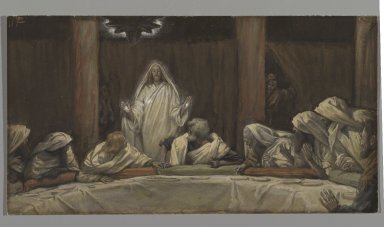
Then Jesus came
(all the doors being shut)
and stood among them.

                              Luci Shaw

The Appearance of Christ at the Cenacle
The Appearance of Christ at the Cenacle (James Tissot)

On every one of them

“I found rest in remembering the hands laid on every one of us, not one of us overlooked, and the hands laid upon us are wounded hands.” (Amy Carmichael)

Rate this:

An encouraging meditation from Amy Carmichael:

Luke 4:40 He laid His hands on every one of them, and healed them.

This verse took life for me one day lately.  I was reading in the Revised Version and looked up the Authorized, to see if I was reading something new, for it felt new.  But no, I must have read it hundreds of times before.
     On every one of them.  It comforted me to know that He does not look upon us as a mass, but as separate needy souls.  I remembered the terrific attack that is always on the love that should hold us together, and I read over and over again John 15.9-17.  I know well that the devil hates and fears strong love.  If he can weaken us there, all goes.  For us, to weaken means to perish.  I found rest in remembering the hands laid on every one of us, not one of us overlooked, and the hands laid upon us are wounded hands.

He heals the lame

You are an icon of Jesus

“Nothing more closely resembles the face of Jesus and of God than the face of a human being, from the most famous to the most miserable.” (Andre Louf)

Rate this:

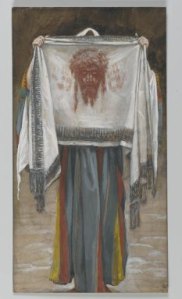
The Holy Face
The Holy Face (James Tissot)

Many of our sisters work with the poor and the marginalized.  Often I hear one or the other of them talking about seeing Jesus “in the distressing disguise of the poor” (Mother Teresa).  This morning I was reading a chapter from Andre Louf’s book, Mercy in Weakness, and came across this: “Nothing more closely resembles the face of Jesus and of God than the face of a human being, from the most famous to the most miserable.”   As I pondered that sentence,  I began to think about how, at the same time as looking for the face of Jesus in others, we need to look for His face in ourselves.  You are I are each an icon of Christ.  As I continued to read the chapter, I came across these confirming words:

The Holy Spirit, from the moment of our baptism, day after day, resculpts in our heart the features of Jesus’ face, not only his physical face but also his ‘spiritual’ face.  Every believer bears the glorious features of Jesus’ face, the holy face of our beloved Saviour, as though it were engraved in his or her heart, usually–sadly enough–without knowing it. 

As we strive to see Christ in others, let’s not miss His beauty in us.  You are an icon of Christ.

Those whom He Himself wanted

Jesus calls each of us because He loves us.

Rate this:

Today is the anniversary of my final vows to our community, The Servants of God’s Love.  This morning before Mass I picked up a book I am reading–for the second or third time–Mercy in Weakness, by Andre Louf.  This is what I read: “Jesus called to him those whom he himself wanted” (Mk 3:13).  Of course, this refers to Jesus’ calling of the twelve apostles, but isn’t it just as true for us, each of us–for, yes, He called me to religious life, but it is just as true that He called you to whatever you said yes to in your own lives.  The RSV says: “those whom he desired”.  Think about that today: God called you, and me, out of desire for you.

A person was simply selected because Jesus preferred him, without any further motives.  Jesus chooses the rich and the poor, Jewish nationalists and collaborators, ordinary people and fishermen.  At the moment of selection what matters is not what these people are.  He simply prefers them because he loves them, each one individually.  Nothing other than Jesus’ love and preference explains this selection.

Calling of St. Peter and St. Andrew (James Tissot)

He prefers you because He loves you, short and simple.  And not just when He called you.  Even now.

Mary Magdalene

A Jessica Powers’ poem on Mary Magdalen.

Rate this:

I’ve done a lot of meditating over the years on today’s gospel.  For many long seasons of my life, I have felt that I have been with Mary weeping outside the tomb, Jesus calling my name, but I keep failing to recognize Him.  Learning to trust Him when I think He’s gone and I can’t recognize Him. (See “While it was still dark”)

Two paintings here of Mary before and after her conversion:

The Magdalene before her conversion (Tissot)
The Magdalene before her conversion (James Tissot)
The repentant Mary Magdalen (James Tissot)


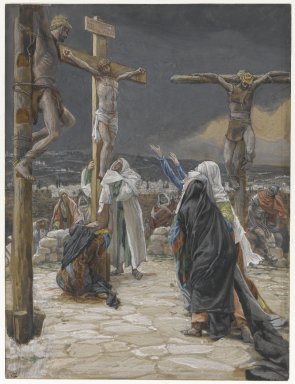
On another note, this poem by Jessica Powers came to mind today.  In this poem, she writes about Mary’s encounter with Christ on the Cross and then her later life, where she lived as a contemplative hermit:

The death of Jesus (James Tissot)

The Blood’s Mystic

Grace guards that moment when the spirit halts
to watch the Magdalen
in the mad turbulence that was her love.
Light hallows those who think about her when
she broke through crowds to the Master’s feet
or ran on Easter morning,
her hair wind-tumbled and cloak awry.
What to her need were the restrictions of
earth’s vain formalities?
She sought, as love so often seeks and finds,
a Radiance that died or seemed to die.

One can surmise she went to Calvary
distraught and weeping, and with loud lament
clung to the cross and beat upon its wood
till Christ’s torn veins spread a soft covering
over her hair and face and colored gown.
She took her First Communion in His Blood.

O the tumultuous Magdalen!  But those
who come upon her in the hush of love
claim the last graces.  A wild parakeet
ceded its being to a mourning dove,
as Bethany had prophesied.  We give
to Old Provence that solitude’s location
where her love brooded, too contemplative
to lift the brief distraction of a wing.
There she became a living consecration
to one remembering.
Magdalen, first to drink the fountained Christ
Whose crimson-signing stills our creature stir,
is the Blood’s mystic.  Was it not the weight
of the warm Blood that slowed and silenced her?

The hands of love

The man born blind

Rate this:

Some things in life are hard to understand and to deal with–especially those terrible  things that happen to the innocent, especially when it’s our own children.  In his ninth chapter, John tells the story of the man born blind.  My brother, Rod, is legally blind as a result of his diabetes, and it has proved a great challenge to him.  I am currently reading the letters of Bede Jarrett, a provincial of the English Province of Dominicans from 1916-1932.  He has a thought-provoking reflection on John 9:

Think what it means to be born blind.  He could do nothing for himself, except what he had learned with great labour and trouble.  It must have seemed the worst possible thing to him.  Think of him as a child, a boy with all his strength for, as far as we know, he was otherwise perfectly healthy, his pent-up energy, and he couldn’t walk, ride or swim without someone coming to help and guide him, and tell him which way to go.  If you described the beauty of a flower, or the bloom of a fruit, to him, it meant nothing; he was born blind.  Horrible, hideous–and yet, what does our Lord say?  The apostles, seeing him, said, ‘Lord, who has sinned, this man or his parents that he should be born blind?’ Of course they put it down to sin (the Pharisees had a doctrine that a man could sin even in his mother’s womb), and our Lord said, ‘Neither hath this man sinned, nor his parents, but that the works of God should be made manifest in him.’ It was just the fact of his being born blind that made the glory of God so manifest.  ‘It has never been heard of since the world began that  man born blind hath received his sight.’ Others, yes, but never one born blind.  So just what seemed so cruel to him turned out to be this wonderful miracle, making manifest the glory of God.
     So we see that all circumstances, however adverse they seem to be to us, are always favorable to God’s plan, always, always, as to the blind man, the best thing for us.
     His hands are strong and powerful hands and we can confidently rest there.  Can we not sometimes see in the hands of a clever artist, or surgeon, the strength and deftness expressive of the mind that directs their action?  But with God, they are not only the hands of power, and not only the hands of wisdom, but of love, and it is only when we leave all things in his hands that we find complete serenity; and then a great peace shall come into our souls.

The blind man washes in the pool of Siloam (James Tissot)

The pharisee became the publican

The parable of the Pharisee and the publican applied with a new twist.

Rate this:

The Pharisee and the Publican (James Tissot)Another thing that can cause me discouragement sometimes is dealing with besetting sin–you know that thing you keep taking back to confession over and over.  One of mine is critical thinking.  A few years ago I read Sr. Ruth Burrow’s autobiography, and in it she spoke about this being one of her ongoing faults as well.  However, she found what I think is a very clever way to deal with it:

Perceptive, quick to see the flaws in another, I was prone to criticism, finding a certain satisfaction in seeing another at fault as though this, in some way, raised me up.  I knew that no fault would so displease our Lord or stop his grace as this harsh judgment on his children.  I realized I had the mentality of a pharisee but, I thought to myself, if a pharisee had turned to our Lord and admitted his hardness of heart, his crabbed, mean spirit and asked for help, our Lord would have helped him.  So I did the same.  The pharisee became the publican.  I came to realize that temptations to pride, the sin of the pharisee, could make one a publican.  The stone which the builders rejected could become head of the corner.  I tried to use these bad tendencies to grow in humility.

And the Angels danced, don’t you think?

The power of wounding His Heart

The simplest glance of our eyes wounds and ravishes the Heart of Christ.

Rate this:

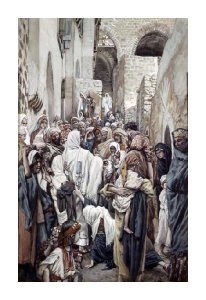
Healing of the woman with an issue of blood

  Reflecting on today’s Gospel (Mark 5) about the woman with the flow of blood who reaches out and touches Christ’s garment, I remember this pithy quote from Gilbert of Hoyland: “The woman touched but the hem of His garment, and Christ felt virtue go forth from Him.  How much more is it when His Heart is not only lightly touched, but wounded.”  And how do we wound His Heart? The word is meant in a good sense here, as in Song of Songs 4:9: “You have ravished (Vulgate: wounded) my heart, my sister my bride, you have ravished (wounded) my heart with a glance of your eyes, with one jewel of your necklace.”   What power we have over the Heart of our Beloved Lord, that just a single glance from us–throughout our busy days–ravishes and wounds His Heart. . .  Do not underestimate the simplest lifting up of your heart to Him, the simplest glance of your eyes.

But she came and worshipped him

This, by Amy Carmichael, has made me reflect on my own response to what I would consider “undeserved” remarks.  (I put “undeserved” in quotation marks because if I really reflect on my true state, I realize how I deserve even more. 🙂  Amy is reflecting on the story of the Canaanite woman who came to Jesus begging healing for her daughter.  If you remember, the disciples wanted to send her away, and Jesus cryptically replied: “I was sent only to the lost sheep of the house of Israel.” 
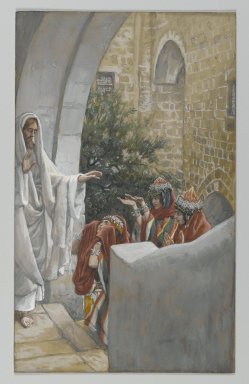
The Canaanite woman (James Tissot)Mt. 15:25  But she came and worshipped Him.

Her prayer had met first silence, and then a perplexing answer, for she must have heard our Lord Jesus’ words to His disciples, and she would know what they meant.  It was all perplexity then, and disappointment.  But she came and worshipped. . . .
     These words spoke to my heart today.  Sometimes our prayer does not at once meet with the response we expected, and the temptation then is to discouragement. “But she came and worshipped.”
     May the Lord work in us both to will and to do, so that conquering the natural inclination of our weak hearts, we shall turn our disappointments to causes and occasions for worship.  Worship may lead to renewed intercession, as it did in this blessed story, but first let there be worship, the adoration of the lover, the quietness of faith.    (Edges of His Ways)

And that brought to mind the incredible response of Job after he lost his servants, sheep, ox, asses, camels, and his sons and daughters (certainly a greater trial than a few hard words): Then Job arose, and rent his robe, and shaved his head, and fell upon the ground and worshipped (Job 1:20). 

May it be the same with us.

[Note: for an excellent exposition of the story of the Canaanite woman–one that I’ve struggled to understand for years–read Erasmo Leiva-Merikakis’s Fire of Mercy, Heart of the Word, Meditations on the Gospel of Matthew, Vol. 1, “Dog in Search of Master.” ]
When you feel like you have nothing left to give . . .

Like the poor widow, Jesus is more pleased when we give from our poverty than when we give from our abundance.

Rate this:

Widow's MiteIn my position as superior of our community, there are many days when I feel like I don’t have anything to give my sisters–not that I don’t want to–I just feel very poor.  I also feel that way pretty much all the time in prayer these days.  I have always experienced great encouragement from the story of the widow’s mite.  Some words on this topic from Andre Louf, abbot emeritus of the Cistercian monastery of Mont-des-Cats, France:

Jesus was elated over the poor widow who offered two copper coins.  She gave from her poverty and in so doing offered up everything she had to live on (Mk 12:42-44).  The others had also given money, a lot of it even, but “from their surplus wealth” . . . Jesus, however, preferred the two miserable coins of the widow to these substantial gifts even though the coins were of no significance in the sum total of the collection.    Why did he rate this gift more highly?  Jesus’ answer was very simple: “She, from her poverty, put in everything she had, all she had to live on.”  Does this mean the others should have been more generous?  Should they have given larger sums?  Of course not.  They were naturally free to do this and a higher contribution would certainly have been appreciated.  But that was not what was important to Jesus; the issue was not so much one of quantity.  Even if the rich were to give more, they would still only be giving from their abundance.  For them it would always remain immensely difficult to give from their poverty.  It is the same for us: whatever we may give of all the things that belong to us–our money, our time, our magnanimity, our health, our thousand good qualities–even if we put all this at Jesus’ disposal, still we are only giving from our abundance.  And it will always remain hard and even painful for us to give from our poverty.  To give everything to Jesus always means to give from our poverty and that is not an easy thing to do.  But it is precisely this gift that Jesus expects from us all . . . To give from our poverty means, first of all, to know that we are poor, that we have discovered in ourselves the wound for which (for that matter) no one is responsible but which for ever makes us utterly poor indeed, poor to a degree we would not dare to admit to ourselves. . . [The widow] accepts the fact that she just wants to give what she has because Jesus looked at her and accepted her as she was.  Happy are they who dare to give from their poverty: in the eyes of Jesus they have given everything they had.   (from Mercy in Weakness)