The blessing of the unoffended

Today being the feast of the Passion of St. John the Baptist, I cannot help but return to something about which I have posted before, and that is: the blessing of not being offended by however and whatever God is doing.  In Luke 7, we read about John being in prison.  He sends word to Jesus wondering, “Are you he who is to come, or shall we look for another?”  A puzzling thing for John, of all people, to ask.  However, considering his situation at the time, not surprising.  He’s in prison.  Jesus has not come to visit him (as far as we know).  So, as for many of us, it would be perfectly understandable to start dealing with doubts about Jesus.

I find Jesus’ answer even more astounding than John’s question.  Jesus instructs John’s disciples to go to him and recite a list of the many wonders that Jesus has done.  And then He concludes with that mysterious phrase: “And blessed is he who takes no offense at me.”   Amy Carmichael was the one who unlocked this mystery for me.  She refers to this verse many times in her writings.  I’ll let her speak for herself . . . any may each of you respond to the grace of becoming one of the “unoffended.”   She writes from the perspective of John’s thinking as he is listening to the report of his disciples:
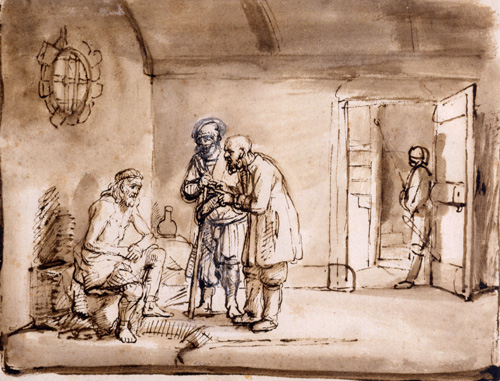
St. John the Baptist in Prison receives Christ’s answer, (Matthew 11: 2-6)
Samuel van Hoogstraten (1627 – 1678)

Before they got to the end of the mighty things they were to tell him, his heart must have kindled with new hope: My Lord can do all that, He is doing all that, He is omnipotent.  He is my loving Lord, and He is very near.  I shall soon be free–He who is opening the prison doors of death will open my prison door.  Can you not all but hear him say it, or at least feel him think it, as he listens to the story of ‘what things’ these men of his ‘have seen and heard’?  And then, instead of a promise, a quick help, ‘Blessed is he who takes no offense at Me,’ and that was all.  But it was enough.  John accepted the unexplained.  And a light shone in the cell, and in that light he lived till his prison door opened, and he stepped across its threshold into the Land of Light.

To many of you this is a familiar word, but to me it came afresh as I read these two verses one after the other last night [Luke 7.22,23], and it spoke to me as I thought of the many who are being trusted not to be offended in Him.

Let us pray for each other to each be able to accept the unexplained and not be offended in Him.

The Love of the Father (4)

More from Fr. Langford on the love of God for us:

“The God who delights in us does not do so from a distance.  His longing for union with us, draws him to us constantly.  God’s thirst draws him closer to us than we can imagine, closer than we are to ourselves.”

“God attends to every breath we take and every movement of our inmost heart with the fullness of his being.  His presence to us is never just a portion of himself–as if the billions of people on the planet only had claim to their tiny portion of the Godhead.  God is present to each of us with the totality of his being.  No part of the Godhead is ever absent, or distracted, from any of us–so much so even ‘the hairs of your head are all numbered’ (Luke 12.7).

“God’s entire being attends to every faintest whisper of our soul–just as a mother who listens in the night for the breathing of her newborn.  We each have, as it were, a personal channel connecting us to God, our own individual frequency to which he is tuned day and night.  Even when we are not speaking to or thinking of him, God is listening to us.”

My heart is singing

A Sunday-poem from Amy Carmichael:

Too High for Me

I have no word,
But neither hath the bird,
And it is heard;
My heart is singing, singing all day long,
In quiet joy to Thee who art my Song.

For as Thy majesty,
So is Thy mercy,
So is Thy mercy,
My Lord and my God.

How intimate
Thy ways with those who wait
About Thy gate:
But who could show the fashion of such ways
In human words, and hymn them to Thy praise?

Too high for me,
Far shining mystery,
Too high to see;
But not too high to know, though out of reach
Of words to sing its gladness into speech.

Friday: from the archives

A day or two ago one who was with me prayed like this, “Lord, help me to welcome interruptions, especially when the interruption seems less important than the work I am trying to do.”  That prayer has often been mine.  I expect many of you have felt the need of the loving grace of the Lord to help you to welcome interruptions, especially when they do not seem to matter nearly so much as what we are doing at the moment.  Thinking of this, I found myself this early morning in Lk. 9.11.  The people followed our Lord Jesus (He had wanted to be alone with His disciples just then), and He welcomed them.

It is so easy to be too preoccupied to be welcoming.  May the love of our Lord Jesus, for whose sake and in whose service we are here, so overflow from us that it will be natural for us to do as He would and be welcoming.

(Amy Carmichael, Thou Givest . . . They Gather, p. 94)

The Love of the Father (3)

More from Mother Teresa’s Secret Fire:

“You are precious to Him.  He loves you, and He loves you so tenderly that He carved you on the palm of His hand.  When your heart feels restless, when your heart feels hurt, when your heart feels like breaking, remember, I am precious to Him, He loves me.  He has called me by name.  I am His.” (Mother Teresa)

The Love of the Father (2)

Continuing from Mother Teresa’s Secret Fire.  In this selection, Fr. Langford comments on how much God delights in each one of us:

“God’s thirst for us is not dependent on who or how we are. His love is not about us, and does not depend on us–it is rather about him, about a God whose nature it is to love.  Because God is free in loving us, he is likewise free to delight in us.  Since only his freely given love makes us lovable, it is our willing acceptance of that love, our acceptance of his delight [in us], that transforms us and makes us ‘graceful’, and beautiful, and loving in turn.

“Even where there is no beauty in us, God’s love works its divine alchemy, rendering even the least of us beautiful.”

(Now, did you really read that–I mean, in the sense that it is the truth for you?  😉

The love of the Father (1)

I spent a good amount of time during my retreat last week at Our Lady of the Mississippi meditating on sections of Mother Teresa’s Secret Fire (Fr. Joseph Langford).  I don’t think I have quoted very much from that book, and I don’t know why.  It is a veritable treasure mine of truths about the love of God for us.  And so I will sharing some of them with you over the course of the next few days.  I hope they bless you as much as they do me.

“It is staggering to realize that the Father loves all of mankind with the same love, with the same magnitude and the same intensity, with which he loves his divine Son. . . it is God’s nature to love this way, to love with the entirety of his being, and he cannot love us any less.”

“Because God is infinite, his love is not divided, with each of us receiving but a portion.  We each receive the totality, the fullness of divine love, twenty-four hours a day, every day of our lives.”

“. . . the only way to approach God’s thirst for us is to open to it, without insisting on understanding or being worthy.  As theologian Karl Rahner observed, ‘Some things are understood not by grasping, but by allowing oneself to be grasped.'”

O you, whoever you are . . .

There are so many possible words from St. Bernard to share here, but I must share these wonderful words about to whom we should look in our troubles:

O you, whoever you are, who feel that in the tidal wave of this world you are nearer to being tossed about among the squalls and gales than treading on dry land, if you do not want to founder in the tempest, do not avert your eyes from the brightness of this star. When the wind of temptation blows up within you, when you strike upon the rock of temptation, gaze up at this star, call out to Mary. Whether you are being tossed about by the waves of pride or ambition or slander or jealousy, gaze up at this star, call out to Mary. When rage or greed or fleshly desires are battering the skiff of your soul, gaze up at Mary. When the immensity of your sins weighs you down and you are bewildered by the loathsomeness of your conscience, when the terrifying thought of judgment appalls you and you begin to founder in the gulf of sadness and despair, think of Mary. In dangers, in hardships, in every doubt, think of Mary, call out to Mary. Keep her in your mouth, keep her in your heart. Follow the example of her life and you will obtain the favor of her prayer. Following her, you will never go astray. Asking her help, you will never despair. Keeping her in your thoughts, you will never wander away. With your hand in hers, you will never stumble. With her protecting you, you will not be afraid. With her leading you, you will never tire. Her kindness will see you through to the end.

Reality itself

A Sunday-poem about the way God wants to communicate Himself to us through everything He has created:

THE TRUE APPEARANCE OF THE WORD

As the cataract of ignorance falls
from off the eyesight of my soul,
I realize that all this huge Creation
round about me is the Word.

The hitherto quite unattended fact
that these familiar fingers number ten,
like an encounter with some miracle,
suddenly astonishes me

and the newly-opened forsythia flowers
in one corner of the hedge beyond my window
entrance me utterly,
like seeing a model of Resurrection.

Smaller than a grain of sand
in the oceanic vastness of the cosmos,
I realize that this my muttering
by a mysterious grace of the Word,

is no imagined thing, no mere sign,
but Reality itself.

~ Ku Sang (1919-2004), Korean poet