The measure of a father’s love

For the last week and a half I have been pondering a piece written by Fr. Peter John Cameron for this month’s Magnificat.  Perhaps you’ve seen it as well?  For those who haven’t, I would like to include a few sections because he brings together two passages that it never would have occurred to me to juxtapose.  The first is the gospel reading for this coming Sunday, the story of the prodigal son.  The second–well, read on. He begins:

What was it that turned the prodigal son against his father (see Lk 15:11-32)?  Maybe the father was like the famous landowner in the parable of the workers hired late (Mt 20.1-16) who goes out five different times in the course of a single day to employ laborers for his vineyard.  At five o’clock in the evening he hires yet more workers.  And even though these men toil barely an hour, the landowner pays them the usual daily wage–the same salary as all the other laborers.  This sparks an outcry among the workers who have labored all day long bearing “the day’s burden and heat.”  Perhaps the prodigal son was among those who bitterly grumbled against the landowner.  Maybe it was the father’s extravagant display of generosity that provoked the son to demand, “Father, give me the share of your estate that should come to me.”  As if to say: “If you want to be so foolish and wasteful with your money, then give it to me, because I can’t stand being around here anymore if this is the way you want to act.”
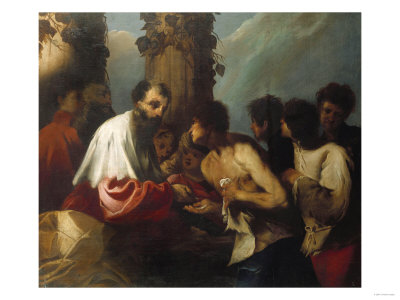
And as Fr. Peter goes on to say: “What can the father do?”  What can we do when someone rails against our generosity? What is our Father to do when we rail against His generosity?

What can the father do?  If he refuses his son, the son will grow sullen and resentful, harboring a grudge that would wreak havoc on the household.  But to give his son the sum and let him go would be like setting the boy on the path of his own self-destruction.  Ironically, the prodigal son forces his father to become a kind of Abraham on Mount Moriah, where God commanded Abraham to sacrifice his son Isaac (see Gen 22.1-14).  In order not to sin against heaven, the father had to put his son in peril: “Then [Abraham] reached out and took the knife to slaughter his son” (Gen 22.10).  Commenting on the father of the parable, the Venerable John Paul II wrote, “The love of the son that springs from the very essence of fatherhood in a way obliges the father to be concerned about the son’s dignity.  This concern is the measure of his love.”  Thus the father hands over the inheritance and lets his son go.

We know the ending, a happy one.  It’s always a risk, but a risk the Father is willing to take–because that’s how much He loves us. When our life seems to be going badly, perhaps it is a result of the Lord letting us go our own way . . . because that is the measure of a Father’s love.


“O what it must have cost the angels”

Today we celebrate the birth of Mary.  I have to say that this morning when I woke up, I felt like breaking into a little song to her, at least “Happy birthday to you . . .”–which sounds so trite–but I knew in my heart that that would be dear to her . . . because she is that kind of Mother.

I want to share the first verse of a poem by Rilke because I think it conveys the sense of joy in the heavens at the birth of this great gift of God to us.

Birth of Mary

O what must it have cost the angels
not suddenly to burst into song, as one bursts into tears,
since indeed they knew: on this night the mother is being
born to the boy, the One, who shall soon appear.

(Rainer Maria Rilke, translated from the German by M.D. Herter Norton)

“He Who Would Be Great Among You”

I felt like dipping into Luci Shaw this morning.

He Who Would Be Great Among You

You, whose birth broke all
the social and biological rules–
son of the poor who accepted
the worship due a king–
child prodigy debating
with the Temple Th. D.s–you
were the kind who used a new math
to multiply bread, fish, faith.
You practiced a radical sociology:
rehabilitated con men &
call girls.  You valued women,
aliens, & other minority groups.
A general practitioner,
you specialized in heart surgery.
Creator, healer, innovator,
shepherd, story-spinner,
weather-maker, botanist,
alchemist, exorcist, iconoclast,
seeker, seer, motive-sifter,
you were always beyond us,
ahead of your own time, & ours.

And we would like to be
like you.  Bold as the James and John,
the Boanerges brothers,
we hear ourselves demand,
“Admit us to your avant-garde.
Grant us degrees in all
the liberal arts of heaven.”
Why our belligerence?  Why
does this whiff of fame and greatness
smell so sweet?
Why do we always compete
to be first?  Have we forgotten
how you took, gently & simply,
cool water, & a towel for our feet?

~Luci Shaw

Perfectly Human

Amy Julia Becker, with whom I disagree on some issues, has a marvelous weekly post for guest authors called “Perfectly Human**”.  Here is her description of the purpose of this column:

This weekly feature is intended to provide a picture of life with a disability in all its possibilities and limitations, gifts and struggles. The title of this feature comes from the Greek word telos, which can be translated as “perfect” but which also can be defined as, “the end for which it was created.” People with disabilities are just as human as anyone else–flawed and gifted, beloved and broken. They are “perfectly” human, which is to say, created with a purpose. This space is intended to convey the things that connect us as human beings, things that go beyond our perceptions of able/disabled. And this space is intended to suggest ways in which individuals with disabilities can, at least sometimes, help individuals without disabilities to understand their own humanity.

This is this week’s entry: “All People Are Messy.” I hope you enjoy it as much as I do.

Never an option

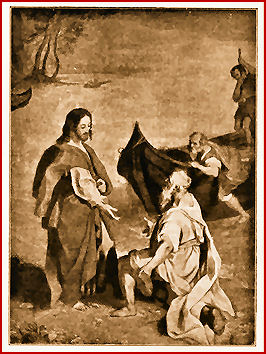
I was so struck this morning by this introductory comment to today’s Mass readings from Magnificat.  The gospel recounts the story of Peter asking Christ to depart from him because he is a sinful man.  Magnificat comments:

Peter relies on his limited expertise instead of upon the humble authority of Jesus Christ . . . even regarding fishing.  . . . When Peter’s sin of presumption fills him with shame, he begs Jesus to depart from him–a request that Christ will never honor.

What a Savior we have–One who will never depart from us, even if we beg Him. . .

The thick cloud

Yesterday’s post about the pillar of cloud reminded me of something I read recently.  (Sorry, I haven’t been keeping up with my “What I’m Reading” column . . . ) I recently finished a book about Edith Stein (St. Teresa Benedicta of the Cross) and the Jewish Catholics who went to Auschwitz at the same time as she did.  Most them, like Edith, recognized God’s call on them to offer themselves as some sort of sacrifice for their Jewish brethren. Among them was a group of brothers and sisters from the same family, the Löb family, most of them priests and Sisters.  Their memorial card makes reference to the thick cloud that descended that descended upon Mount Sinai when the Lord revealed Himself to the people of Israel.  We, too, experience times when the Lord comes to us in what seems to be a thick cloud.  Let us take courage from the Löb siblings’ ability to recognize God in the one that covered them.

“Behold, I am coming to you in a thick cloud” (Ex 19.9).

We read these words in the Book of Moses that recounted the Exodus of the Jews.  We can apply these words to these chosen souls, who came from that same people to whom God appeared on the holy mountain. The holy mountain is the contemplative cloister.  On that mountain they were praying during the night, when the cloud descended upon them.  From a purely human perspective, this cloud, ominous and inescapable, would be nothing more than a threat.  From this cloud, however, they heard the voice of God.  Though each had his own path, they were one in their noble surrender to God’s holy will, and they recognized with joy their chosen lot.  And we saw them go.

Fight against those who fight against me

A little encouragement from Amy Carmichael this morning:

Ps 35.1 Fight against those who fight against me.
Ps 35.3 (Kay) Be a barrier against my pursuers.

What are the things that fight against me?  Let us not lose the comfort and power that is in this word for us by relating the prayer to the larger things only, it touches the smallest.  The wave that sweeps over the great rock, is the same that sweeps over the tiny shell on the shore.  It is the little things of life, the minute unimportant-looking things, that are most likely to shatter our peace; because they are so small that we are very likely to fight them ourselves, instead of looking up at once to our Strong God, our Barrier between us and them.  “Close the gate, or bar up the way:–as the cloudy pillar formed a barricade between the Egyptians and Israel” is Kay’s note.

Fight against those who fight against me–the feelings, the little foolish feelings that want to keep us back from saying to the blessed Will of God “I am content to do it” [Ps 40.10], fight Thou against them, O God; “and my soul shall be joyful in the Lord: it shall rejoice in His salvation . . . Lord, Who is like unto Thee, Who deliverest the poor from him that is too strong for him?” [Ps 35.9, 10]

What a joyful life ours is, continually proving His tenderness in the very little things.  There is nothing too small for Him to help.  He is indeed a Barrier between us and our pursuers.  How precious is His lovingkindness. [Ps 36.7]  Now for a day of joy!