“Those Endless Dishes”

As we move back into Ordinary Time, I thought you might be inspired by this article by Catherine Doherty about doing the mundane things of life:

THOSE ENDLESS DISHES

by Catherine Doherty

Recently my prayer has been spearheaded by a remark of one of our members who said that she wished that she had something “to sink her teeth into.” Upon discussion I found that this was a general feeling in a small group that was chatting together. They felt that Madonna House life, or part of it, had become unchallenging and monotonous.

They spoke of the office and its constant routine: writing endless letters, changing addresses, answering the telephone, doing the bookkeeping, and so forth.

Then they spoke of the sameness of the kitchen: preparing endless meals and getting them to the table, and washing dishes that seem to pile up like an enormous fortress to which there is no entrance.

Then there are the literally tons of clothing to sort. (They didn’t mention the laundry or the work of the men at the farm or other constant repetitive “chores” that need to be done over and over by other members of Madonna House.)

Yes, we are forever surrounded by tasks that appear to be dull, monotonous, routine, unchallenging. I listened to all of this chitchat and to the tremendous desires which seemed to animate the people who were talking.

They were not just idly talking; neither were they at all upset. They were simply “presenting their ideas.” But as they continued to talk, their voices suddenly did not reach me any more. Somehow I was lost in Palestine. I saw a hammer, a chisel, a hand-plane. Somehow I was utterly astounded—as if I had never thought of it before—by a carpenter’s shop.

The challenge it presented was beyond my ability to absorb.

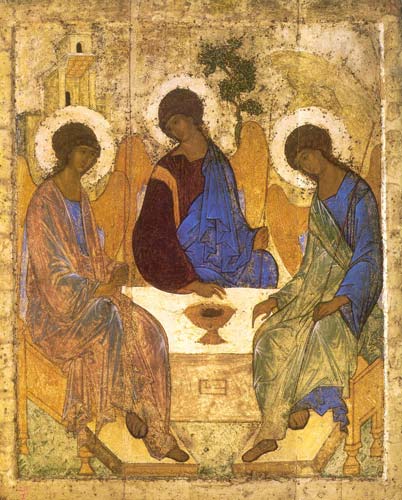
The Second Person of the Most Blessed Trinity—someone who could have been a rabbi, a king, an emperor, a philosopher, a man of tremendous renown, someone at whose feet the whole world would come to sit and listen—this awesome Person was right there, bent over a work bench in that shop, chiseling and planing pieces of wood.

He was doing little “unimportant” tasks: building a table for someone, making a cradle for someone else, crafting a chair for another.

I saw his calloused hands (for he did have calloused hands!) and I asked myself: Why did he choose such humble, uninspiring, unchallenging tasks?

Once you knew how to do them, they could never be called things “to sink your teeth into.” On some side street in an unimportant village, he did the work of an ordinary carpenter, just as his foster father did.

And what did his mother do? She washed and scrubbed and took the laundry to the river, and she milled the kernels of wheat manually between two stones. She wove cloth; it is said that she wove the cloak that the Romans threw dice for because it was so beautiful.

I began to hear again the evening discussion about the mounds of dishes, the eternal sorting of donations, the answering of phones, the filing of cards, the dulling rhythm of seemingly unimportant tasks.

It all became filled with a strange glow and I understood the fantastic, incredible, holy words contained in that sentence: the duty of the moment is the duty of God.

I also understood that anything done for him is glamorous, exciting, wondrous if only we can see it for what it truly is!

But we are human. And it takes a long time, my dearly beloved ones, to see reality through God’s eyes. Unless we pray exceedingly hard, it takes a long time to “make straight the ways of the Lord” in our souls.

When we experience this pain in our lives, this pain of making straight the paths of the Lord, it would be a good idea to remind ourselves that this pain is everywhere in every vocation, in every kind of work. It is part of the human condition.

The answer to that pain, in Madonna House or anywhere else, is prayer. Nothing else will do it; nothing else.

But—with prayer—we see an entirely different world around us. Sorting clothes becomes a joy. Washing dishes becomes an exciting challenge. The careful repetitious tasks of creating beauty (as in embroidery, weaving, painting, or carpentry) take on a new meaning.

Yes, I came back from wherever I was, watching Jesus doing carpentry work, and I thanked God that he became a manual laborer to show us the way to the Father. There is much more that I could say, but this will suffice for today.

Adapted from a letter to the staff, Oct. 1976, in Dearly Beloved, Vol. 3, available from MH Publications.
Power made perfect in infirmity

What is a more powerful expression of the power of the Holy Spirit than His work in our personal lives, especially in our areas of weakness?  This Sunday’s poem is by Mother Mary Francis about that very thing.

A Scriptural Commentary

“For power is made perfect in infirmity” (2 Corinthians 12.9)

Predictable Your power, God,
Who shake the heavens into thunderous roar
And split the skies with lightning at Your glance.

You gaze at oceans and they leap
To speak response in crash of waves
And then subside in wonder at Your feet.

Only to think on seed need You
To see a thousand forests rise to praise You,
Hear treble of small blossoms find their voice.

Wave of Your raised almighty hand’s
Enough to call the sun to rise or set,
To light the sky-dome with ten million stars.

Never will skies impediment Your power
Nor oceans strain Your energies, nor earth
Challenge Your might, stand stubborn before Your gaze.

I do applaud Your power, God.
How effortless Your cosmic sovereignty!
Your easy might is something to admire.

Power is wondrous for no need
Of labor, power issued without threat.
But shall unthreatened power be best praise

Of You, O God? Could greater be
Praise of Your laboring omnipotence
To bend a stubborn heart, to tame a will?

I weep to see You strain to win
So small a prize, tense to achieve
Your purpose, and with all the odds against You.

O God, dear God, what wondrous might
Is Yours displayed in me!
Your power made perfect in my infirmity!

Envoi:  Take, God, the scope I bring You
For play of power. See!
And my own power found at last
In my infirmity.

The Holy Spirit, the Innkeeper

A few more quotes from Come Creator Spirit:

‘a humble and contrite heart’ is the place of rest, a kind of paradise on earth, the place to which God feels most drawn (see Is 66.1-2).  We human beings cannot offer God any sacrifice more pleasing, more acceptable to God than a contrite heart (Ps 51.19).  And what is there to stop us burning with desire to have God fine, every time God visits us, this secret place, this place of rest, that God loves so much.

. . . there is a connection between the Spirit and hope is as close as the connection between the Spirit and love.

Iranaeus says that the Holy Spirit is the “innkeeper” to whom the Good Samaritan, Christ, entrusts wounded humanity, asking the Spirit to take care of it.

The Gift of God

If you haven’t read Fr. Cantalamessa’s book, Come, Creator Spirit, I would be so bold as to say you must.  I’ve read it twice and will most certainly read it again at least once.  Some quotes to entice you:

[quoting Thomas Aquinas]”The first gift we give to someone we love is love itself, which makes us long for the good of that person.  Thus it is that love itself is the primary gift, in the strength of which we offer all other gifts that we are able to give.  And so it is that from the moment the Holy Spirit proceeds as love, he proceeds as the primary gift.”  From all of this it follows that the Holy Spirit by pouring the love of God into our hearts, infuses into us not only a virtue, even though it is the greatest of all the virtues, but pours his very own self into us.  The gift of God is the Giver himself.  We love God by means of God himself within us.

Coming to us, the Holy Spirit not only brings us the gift of God, but also God’s self-giving.

[Commenting on the likeness of the Holy Spirit to a “living fountain”] Water is something that always runs down, never up.  It is always trying to find the lowest place.  So it is with the Holy Spirit: the Spirit loves to visit and fill the lowly, the humble, those who know their own emptiness.

More to come . . .

What does this love look like?


Thinking a little bit more about yesterday’s post and the importance of overcoming the world with God’s love. . .   I think the hardest expression of loving is forgiveness, don’t you?  Charles Williams, reflecting on the phrase from the Lord’s Prayer, “Forgive us our sins as we forgive those who sin against us,” has this to say: “No word in English carries a greater possibility of terror than the little word ‘as’ in that clause.” God calls us to a high standard.  A dying man’s words are chosen carefully.  According to Luke, the words most prominent in Jesus’ mind and heart as He was dying were: “Father, forgive them for they know not what they do.”  If you haven’t had a chance to read this article mentioned in a previous post, it’s worth the time.  This priest’s ability to forgive comes only from the Holy Spirit.  And God promises the same Spirit to us, as long as we ask.

Overcoming the world

The verse for the Canticle of Zechariah in Morning Prayer this morning is: “The world will persecute you, but have courage, I have overcome the world, alleluia.”  I began to think: “How are we to overcome the world?  How did Christ overcome the world?”  The answer that sprang immediately to my mind–and which I trust came from the Holy Spirit–was “By love.”  He, and we, conquere by love. So often, I think, other plans and ideas for overcoming the world spring to our minds, but we must carefully test from where they come, for if they are not underpinned and motivated by love, their source is probably not God.  Perhaps they come from ourselves or from our Enemy.  A story comes to mind from a book I am currently reading, Evidence Not Seen, A Woman’s Miraculous Faith in the Jungles of World War II.  It is the autobiography of Darlene Deibler Rose, a young American bride, who with her husband went as missionaries to Dutch New Guinea shortly before WWII.  She and her husband were interred in separate Japanese concentration camps.  She suffered under horrific conditions and oppressors.  Her husband died.  Yet her faith remained strong despite her suffering.  The story that came to mind has to do with her relationship with the Japanese commander of her camp who would beat the women savagely for any infraction.  Many days she had to struggle internally to obey Jesus’ command to love our enemies. One day she was called into his office.  She boldly asked if she could have permission to talk with him, which he granted.  She began to witness to him of Christ’s place in her life, ending with: “He died for you, Mr. Yamaji, and He puts love in our hearts–even for those who are our enemies.  That’s why I don’t hate you, Mr. Yamaji.  Maybe God brought me to this place and this time to tell you He loves you.”  She continues in her book, “With tears running down his cheeks, he rose hastily and went into his bedroom, closing the door.  I could hear him blowing his nose and knew he was still crying.”

This all brought to mind an excerpt from a letter written by Caryll Houselander, a contemporary of Darlene, at the beginning of World War II.  She, too, was dealing with the suffering of many.  She wrote:

When the first days of this agony [WWII] are over, it is going to lead on from suffering to suffering in every way, fear, loss, death–one can’t bear to think of it.  Our work is to keep alive, a deep constant awareness of the living love of God, to be, as never before contemplatives of Christ in ourselves and in one another. To keep His passion before us and to keep our faith in His love, never allowing the despair and pessimism which must sweep many hearts.

Sopranos and basses

Remember to look for God and His love for you in all things today.  Listen for His voice:

The bird on the branch, the lily in the field, the deer in the forest, the fish in the sea, the numberless companies of happy men, all these proclaim with great joy: God is love!  But from below, and as if carried by all these voices, like the moaning bass below all the high sopranos, we hear, de profundis, the voices of the sacrificed victims [i.e. the martyrs]: God is love.”  (Kierkegaard)

Fear is a trial of faith

I mentioned Fr. Dajczer’s book, Gift of Faith, Monday night at the Witnesses to Hope talk.  I have previously quoted from his book here, but thought I would give you another “teaser”.  As I said, I can’t recommend this book highly enough.

When St. Paul asked Jesus  to remove some kind of difficulty from his life, Christ answered him that power is made perfect in weakness (cf. 2 Cor 12.8-9). . . . So how great is the role of your fear in God’s economy?  It is there to provoke an act of faith within you.  Fear is a trial of faith and that is why God allows it, so that you may grow in faith.  Trust and faith are made perfect amidst fears.

Fear can contribute to illness in many people.  Fear lies at the basis of neuroses and psychoses.  But it can be an outlet to total abandonment to God.  Everything depends on you.  Fear is a challenge issued to you.  What will you do with it?  Will you allow yourself to be enslaved by its weight?  Or, instead will you try to perform acts of abandoning yourself to Him who is infinite power and infinite love . . . . We cannot rid ourselves of fear as an emotional state, at least not always.  Fear, however, can become a factor that deepens our faith, just as each temptation can.  (pp. 52-53)

The Hill Mizar

Did you ever wonder about Mizar in Ps 42–where it was and what was its significance?  (Maybe you didn’t, but have I piqued your curiosity?)  Here’s Amy Carmichael’s take on it:

Ps 42.6  The Hill Mizar

Did you ever feel that you had nothing great enough to be called a trouble, and yet you very much needed help?  I have been finding much encouragement in the hill Mizar.  For Mizar means littleness–the little hill.  The land of Jordan was a place where great floods (the swelling of Jordan) might terrify the soul, and the land of the Hermonites was a place of lions and leopards [FYI: these are the places mentioned in this verse]; but Mizar was only a little hill: and yet the word is, I will “remember You from . . .  the hill Mizar”, from the little hill.

So just where we are, from the place of our little trial, little pain, little difficulty, little temptation (if temptation can ever be little), let us remember our God.  Relief will surely come, and victory and peace; for “the Lord will command His lovingkindness” (v. 8), even to us in our little hill.