“. . . for they shall see God”

It’s still the time, the season, of remembering Christ’s appearances to those He loved.  Let us not move too quickly back into ordinary time.  (Is there ever an “ordinary” time with Christ in our lives?)  Luci Shaw captures this need to learn to recognized Him in this Sunday-poem.  We, too, need to “get beyond the way he looks” in our everyday lives:

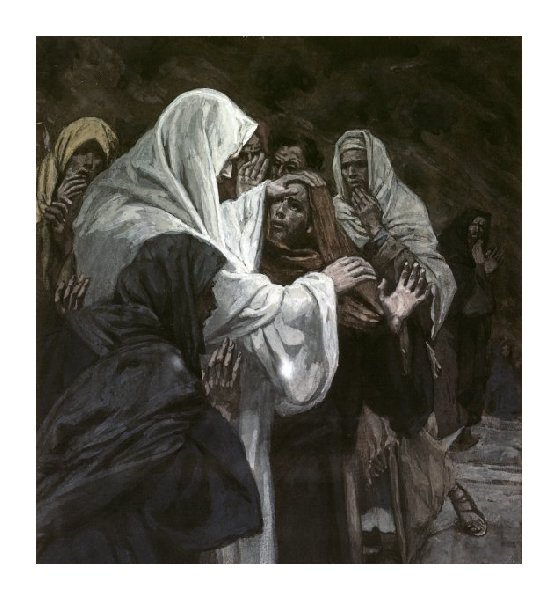
He who has seen Me has seen the Father (James Tissot)

“. . . for they shall see God”

Matthew 5.8

Christ risen was rarely
recognized by sight.
They had to get beyond the way he looked.
Evidence strong than his voice and face and footstep
waited to grow in them, to guide
their groping from despair,
their stretching beyond belief.

We are as blind as they
until the opening of our deeper eyes
shows us the hands that bless
and break our bread,
until we finger
wounds that tell our healing,
or witness a miracle of fish
dawn-caught after our long night
of empty nets.  Handling
his Word, we feel his flesh,
his bones, and hear his voice
calling our early-morning name.

~Luci Shaw

“If you are in danger . . .”

A quote for our Lady’s day, today, Saturday:

If you are in danger, she will hasten to free you.  If you are troubled, she will console you.  If you are sick, she will bring you relief.  If you are in need, she will help you.  She does not look to see what kind of person you have been.  She simply comes to a heart that wants to love her.

~Gabriel Possenti

Tenderness

I have been meditating on this quote of St. Thérése’s all week: “God is more tender than a mother.”  If your mother was/is less than tender, then this is comforting, and if your mother was/is a gracious and comforting woman, this is amazing.  Soak it in for all its worth.

That breakfast on the beach

Browsing through my journal, I came across a quote from five years ago that is a wonderful reflection on last Sunday’s gospel:

“Feed my sheep,” Jesus said to Peter as the first rays of the sun went fanning out across the sky, but, before that, he said something else.  The six other men had beached the boat by then and had come up to the charcoal fire knowing that it was Jesus who was standing there and yet not quite knowing, not quite brave enough to ask him if he was the one they were all but certain he was.  He told them to bring him some of the fish they had just hauled in, and then he said something that, if I had to guess, was what brought tears to their eyes if anything did.  The Lamb of God.  The Prince of Peace.  The Dayspring from on High.  Instead of all the extraordinary words we might imagine on his lips, what he said was, “Come and have breakfast.”

I believe he says it to all of us: feed my sheep, his lambs, to be sure, but first to let him feed us–to let him feed us with something of himself.

Look out your window

I really don’t feel inspired this morning  . . . so, when in doubt, turn to Amy Carmichael!

Dan 6.10 His windows being open in his chamber toward Jerusalem.

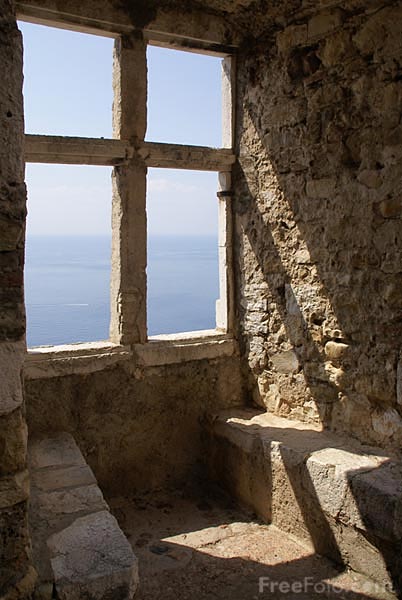
Daniel had only to kneel down upon his knees beside one of those windows, and at once he had access to the Father.  Daniel’s windows almost certainly were very small, set in a thick wall.  We often feel that the windows of are chamber are very small–we see so little, know so little of our Heavenly Jerusalem–but a bird can fly through a very small window out into the wide blue air, and if our windows be open toward Jerusalem, we shall in heart and mind thither ascend.

“Give God that nothing”

I am re-reading a slim volume on Mother Teresa, titled I Loved Jesus in the Night.  This book increases my hope whenever I pick it up.  Today while reading, I was reminded of something I wish I would remember  more often–and that is that nothing in our life need be wasted.  We can offer whatever we suffer, however small or insignificant it may seem, to God for the sake of others.  Whenever I do remember this truth, it makes such a world of difference for me.  It lifts me out of my small world of seemingly petty sufferings–mostly of my own making–into God who holds all things in His massive Heart.

If at the time of prayer or meditation it seems to you that not only have you been distracted in your prayer, but that you have done nothing at all, never leave that time or that place of prayer angry or bitter with yourself.  First–turn to God and give God that nothing.  (Mother Teresa)

P.S. I am continually struck by how much Mother Teresa was influence by her namesake, St. Thérèse, who wrote in one of her early letters: “If I felt that I had nothing to offer to Jesus, I would offer Him that nothing.” (LT 76)

“He was one of us, no stranger . . .”

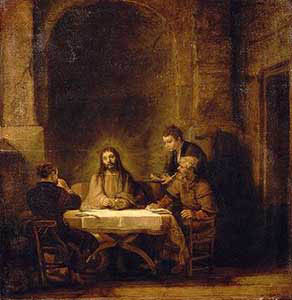
The poem for this Sunday describes the experience of the two disciples on the road to Emmaus:

Companion

When first He joined us, coming, it seemed from nowhere,
and yet, somehow, as if he had followed us a long, long time,
immediately, He was one of us, no stranger, but
a close companion, speaking softly, familiar with our lives,
these days, the answers to our doubts.

And when we moved Him to at least partake of food,
he stood there at the table, not as guest, but host,
and broke the bread to portions, one for each,
then poured the wine, His dark-marked hands
blessing the wine and us.  Was it that act,

His broken hands raised up against the wooden walls,
the prayer-bowed head, the gently spoken word
or some reflection trembling in the wine,
a thickening of air, a luminosity not of wavering light,
that pierced our hearts with joy,

that filled our mouths with praise?  O praise!
O joy!  Then suddenly the light withdrawn,
no longer form and lifted hands above the bread.
Stumbling, we found the road to town,
knowing that never, never would we walk alone again.

~Marie J. Post (all rights reserved)

“I have nothing to offer you.”

On today, Mary’s day, here are some thoughts from Paul Claudel:

Midday.  I see the open church.
It draws me within.
I did not come, Mother of Jesus Christ,
to pray.
I have nothing to offer you.
Nor to ask of you.
I only come, O my Mother,
To gaze at you,
To see you, to cry simply out of joy.
Because I know that I am your child,
And that you are there.
~ Paul Claudel

Leaning upon your Beloved

From Amy Carmichael:

I want to give you a word that helped me all yesterday and will help me today.  It is the “through” of Psalm 84.6 [“As they go through the bitter valley, they make it a place of springs”] and of Isaiah 43.2 [“When you pass through the waters I will be with you; and through the rivers, they shall not overwhelm you”], taken with Song of Songs 8.5 [“Who is that coming up from the wilderness, leaning upon her beloved?”].

We are never staying in the valley or the rough waters; we are always only passing through them, just as the bride in the Song of Songs is seen coming up from the wilderness leaning upon her Beloved.

So whatever the valley is, or however rough the waters are, we won’t fear.  Leaning upon our Beloved we shall come up from the wilderness and, as Psalm 84.6 says, even use the valley as a well, make it a well.  We shall find the living waters there and drink of them.

Sail at an angle

I want to share an excerpt from a book I’m reading, Wild Child, Waiting Mom–written by the mother when her daughter (with two young children) was once again making a bad decision about her life (and the life of her children).  The mother was very tempted to slide into depression–she and her husband had been praying for their daughter for years with seemingly no impact.

In the midst of these difficulties, emotional fatigue and ensuing discouragement were an ever-present danger.  For me during these excruciatingly painful days in Ithaca, I made a conscious decision to take my eyes off my problems and fix them on the Lord.

I clung to an analogy that Dan [her husband who was a pastor] had taught while we worked in Fort Wilderness in Wisconsin.  Several times Dan had the opportunity to teach Bible lessons on a weeklong sailing junket, and I was privileged to go along.

One day when the wind was very strong, Dan asked the captain just how his vessel (a three-mast schooner) could sail headlong into the winds blowing against us.  The captain explained that when a sailboat is sailing against a strong wind, the vessel can’t make progress, and, in fact, endangers itself.  What the ship has to do is to tack back and forth–sail at an angle, creating a vacuum on the back side of the sail that actually pulls the ship forward.

Dan has used this analogy many times in his teaching, applying it to the hardships in life.  Gleaned from our 20-year journey of the harsh winds of Wendi’s rebellion, we can speak with assurance–this works.

Dan expresses it this way: Don’t face directly into the problem, but rather, when adverse winds arise, just turn your mind toward the Lord.  Then, “as the troubles come toward you, let them just whip on by. As they do, it will create that pull toward God.  In that way the trials of life will pull you toward the Lord.  Learn how to tack as you sail spiritually against the wind.”

Turning my eyes toward the Lord took my eyes off the problem and helped me actually make progress in my spiritual life-journey instead of being “blown away.”  (Karilee Hayden, Wild Child, Waiting Mom, Finding Hope in the Midst of Heartache, pp. 209-210)