Two good friends of mine

One of the things I find most delightful is introducing good friends of mine to each other.  That recently happened to me again.  If any of you have checked out the “Biographies” section under the “Books to Read” tab in this blog, you’ve seen that I have read two books about Father Arseny, an Orthodox priest who served time in Russian prison camps,  a number of times.  Hence, he has become a good friend.  I have often said about him, “I want to be like him when I grow up.” I recently introduced him to Anthony Esolen, a professor at Providence College (who has also become a good friend).  Professor Esolen writes for Touchstone magazine and, as many of you have probably noticed, for Magnificat.  He recently commented on an article about a priest in a concentration camp who heard the confession of one of his tormentors and the magnanimity of love he showed him.  Having read Professor Esolen’s comments, Fr. Arseny immediately came to mind so I sent the two books off to him in the hope that he would value meeting him as much as I have.  Here are his comments about the books: “The Beauty of the Saints.”

And my hope is that each of you get to know each of them.  Remember I love it when my good friends meet each other.

(I know I included a lot of links in this post–all of them worth reading.  If you only have time to read one, read the last: “The Beauty of the Saints”.)

Pushing God aside

“At the heart of all temptations is the act of pushing God aside because we perceive him as secondary, if not actually superfluous and annoying, in comparison with all the apparently far more urgent matters that fill our lives.” (Pope Benedict XVI)

And why do we do this?  Is it not because we forget who God truly is?  For if we remembered, we would never push Him aside, would we?  This is, in fact, my biggest temptation these days.  I have brought this to confession numerous times these past months.  For me, I push Him aside not so much because of the urgency of other matters–although that has been a big factor this past week–but because I am one of “little faith”, diminishing God to my idea of who I think He is, reducing His love to my narrow ideas of it.  Over and over again, I have had to decide to trust Him, to put my trust in who He says He is, rather than in my apparent experience at the moment—to let Him lead me out into the “wilderness” and there speak tenderly to my heart . . .  (Cf. Hosea 2.14)

and Angels danced

A wonderful poem about the joy of the angels when any of us repents of our sin:

Choreography for Angels

I say to you, that there is joy among the angels in heaven upon one sinner doing penance . . . (Luke 15.10)

Who spun these Angels into dance
When wars are needing artillery
Of spirits’ cannonading.  Armistice
Wants first the over-powering wings, and they
Are occupied with pirouettes!  Who did this?

Gone penitent, I caused it.  I confess it.

Who tilted flames of Seraphim
In arabesques of pure delightedness?
Is not the cosmic crisis begging fire
For full destruction of hate’s hazarding?
Why Seraphs swirling flames on floors of heaven?

I lit the heavens, when I bent my head.

Who lined mystic corps-de-ballet
Of Cherubim?  Who set in pas-de-deux
This Power with this Principality?
Why these Archangels not on mission sent
Today, but waltzing on stars, and singing?

I am the one who did this.  I confess it.
I smote my errant heart, and Angels danced.

~Mother Mary Francis (Summon Spirit’s Cry)

What is your address?

Tomorrow’s Gospel is about Jesus being led into the wilderness.  I am borrowing an article from Madonna House again today.  (One of the reasons that I love Madonna House articles is that they are so down to earth.)  This one is about looking at Jesus while we’re in the wilderness with Him and not at the desert.

What Is Your Address?

by Fr. Denis Lemieux.

Here is a composite of a series of conversations I’ve had recently:

Ring, ring… (Standard corporate North America telephone routine begins.)… push one-push two, working my way through the voice-mail maze… music, waiting… “Your call is important to us”… more music…

Finally, a friendly, human, non-electronic voice: “Hello, customer service. How may I help you?”

“Hello, I’m phoning to inform you of a change of address for my (bank statement/credit card bill/subscription to your magazine).”

“Would you give me your name and current mailing address.”

“My name is Fr. Denis Lemieux, and my current address is…”

I go blank. What is my address? Where am I? Which of eight possible addresses does this particular corporation have me at?

I yell down the hall at the parish secretary. “Martha, what’s the address here?” She gives it to me. I try it out on the friendly, non-electronic, customer-service lady. No. That’s not the one she has.

I try my previous address. This one works. I give my new address, thank her for her friendly manner. Just before hanging up, I say, “My life has been kind of unsettled lately.” “Sounds like it,” she replies.

In the last five years, I have moved fourteen times—four moves back and forth between the seminary and Madonna House (for the summer), four short-term assignments to MH field-houses, and (after ordination a year and a half ago) two short-term parish assignments.

That’s a lot of packing, unpacking, shunting around of boxes, names to learn, household routines and layouts to orient to, plane, train, and automobile trips.

So, perhaps I can be excused for the occasional memory lapse.

But that’s all behind me now, as I return to Madonna House in Combermere (move number fifteen!) to begin my (God-willing) looooong-term assignment to the training center here. It is good to be home, and even better to be able to put my suitcases into storage, at least for a while.

Starting over. New life. Beginning again. The phrases all have a nice ring for me at the moment.

Now that I’m back where I started from before “the moving years” began, it’s time to catch my breath, take stock, pull up my socks in any areas of life that need that particular wardrobe adjustment, and generally put my house in order, externally and internally.

It’s something we all need to do once in a while—start over. We even say it at times, especially when things have gone wrong. When life has become hard, relationships have failed, some situation or other has blown up in our faces. “I wish I could start from scratch…. I just want to go back to square one.”

I recall a line from a recent movie. One of the lead characters has made a mess of her life, and at a moment of crisis, cries out in despair, “I want to be a baby again. I want to be new.”

Lent is all about this poignant desire, all about this experience of wanting to start over, of wanting to be new. Every year the Church issues us an invitation, in its liturgical cycle, to catch our breath, to take stock, to put our houses into order. To start over.

On the First Sunday of Lent this year, we hear of Jesus going into the desert to fast, pray, and confront evil. In this year’s cycle we hear Mark’s telling of the story. Like most of Mark it is short, direct, and to the point.

The Spirit drove Jesus out into the desert, and he remained in the desert for forty days, tempted by Satan. He was among wild beasts, and the angels ministered to him (Mark 1:12-13).

The end. Two sentences, thirty-one words. It is such a short passage compared to Matthew and Luke’s detailed accounts that we can miss the depths it contains.

Jesus in the desert, according to Mark, is starting over again on behalf of the whole human race. Jesus is returning us, in himself, to our original human condition in the Garden.

He is not going into a garden, though, but into a desert, for sin has made the world such. But in this desert, like Adam and Eve, he exists in perfect harmony with the lower creation, the wild beasts, and with the higher creation, the angels.

In this desert, he is tempted like Adam and Eve were. And in this desert, he remains, in obscurity, in hiddenness, in silence, in the Spirit, for forty days.

Back to how it all began, back to “being a baby, being new,” back to humanity in its youth and innocence, yet living this newness and restored innocence in an environment that mirrors the inner spiritual environment of humanity marred by sin.

Lent is here, and the Church is summoning us to one more change of address, one more move. Out to the desert we are to go, out to spend a season with Jesus as he confronts (our) sin and evil in order to bring us to repentance and conversion.

Out to the desert to allow him to restore us to harmony with the lower creation, in this case, the lower part of ourselves. This is what fasting is about. We deny ourselves so that our disordered passions and desires may be tempered and brought into submission to the Holy Spirit dwelling in us.

Out to the desert we go, to be restored also to harmony with the higher creation. To pray, to set our minds more perfectly on God and the things of God. In this is included works of mercy, works of love, because we cannot touch God unless we reach out to our neighbour, to serve him in his need.

We do not go out to the desert, that is, we do not take on the Church’s Lenten project of prayer, fasting, and almsgiving, so as to renew ourselves, or to return ourselves to our lost innocence.

Any attempt at self-renewal, any attempt to make the desert into a garden by our own efforts and through our own abilities, is doomed to utter failure.

Out to the desert we are to go, ultimately because Jesus is there, and he is our only real “fixed address.” And it is in him, and through him, and with him, that we begin again. That we become new as babies, that we receive his gift of a new heaven and a new earth, a new humanity, an ever-new life.

If we look at the desert, look at our sins, look at the hard work of repentance—fasting, prayer, and all that—it is a dismal season. Just one more move in an unsettled life, and won’t it be great to move on to the next place!

But if we look at the One who calls us to the desert, especially if we look into his eyes, then we are home, and all is well. Then the eternal newness of Easter will run through our Lenten days like an underground stream, bringing us life and freshness.

Utterly spent

Yesterday morning I woke up feeling utterly spent.  My/our good friend’s funeral had been the night before.  Hundreds of people had come to the wake and her wonderful funeral–and it was truly wonderful–and needless to say I am exhausted both from my own shock and grief at her death as well as from helping her family from out of town with all the funeral details and packing up her house before they leave to go home.  So yesterday morning, Ash Wednesday, I woke up feeling very, very poor and spent and thinking, “I have utterly nothing left to give.”  And at that moment there was a little nudge inside me, reminding me that that is exactly the best place to be at the beginning of Lent: poor and spent.  The best place for God to be able to love me–which is the point of Lent.  Repentance basically is our attempt to get rid of all that separates from Him and His love.  It’s not about giving up things–it’s about giving up what separates us from His love.  As it says in Hosea:  I am going to lure her and lead her out into the wilderness and speak tenderly to her heart (Hosea 2.14)  God wants to speak tenderly to each of our hearts this Lent.  Let’s not get so caught up in giving up things for the sake of giving up things that we miss that.

(for a related post, see “When you feel like you have nothing left to give”)

Arise, belovèd, come

A very good and dear friend died very unexpectedly from cardiac arrest yesterday. . . .  This song we sing keeps going over and over in my mind:

“Arise, belovèd, come,
For spring adorns the land;
The vine in flower will bear sweet fruit;
Arise, and take my hand.”

The voice of Christ impelled
Her heart to rise and go
To hidden places carved in rock
That only lovers know.

“Arise, beloved, come,
and let me see your face,
and I will be your summer sun,
and you my dwelling place.”

She lived in faithful prayer,
The Sun her constant flame
Through autumn gold and winter snow,
Until he called her name:

“Arise, belovèd, come,
For summer walks the land.
The vine in flower has borne its fruit,
The harvest is at hand.”

~Genevieve Glen, OSB

Look at the chickadee

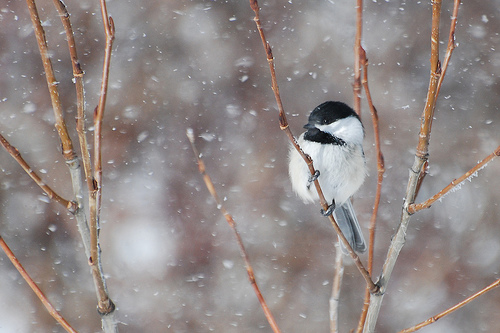
A beautiful snow last night and this morning a bird singing outside my window.  This brings to mind a poem by Jessica Powers about a chickadee in a snow storm.  There is always something to be learned from God’s creatures if we just take the time to look and ask Him to help us to really see.

Look at the Chickadee

I take my lesson from the chickadee
who in the storm
receives a special fire to keep him warm,
who in the dearth of a December day
can make the seed of a dead weed his stay,
so simple and so small,
and yet the hardiest hunter of them all.

The world is winter now and I who go
loving no venture half so much as snow,
in this white blinding desert have been sent
a most concise and charming argument.
To those who seek to flout austerity,
who have a doubt of God’s solicitude
for even the most trivial of His brood,
to those whose minds are chilled with misery
I have this brief audacious word to say:
look at the chickadee,
that small perennial singer of the earth,
who makes the week of a December day
the pivot of his mirth.

~Jessica Powers

The musician

A story from St. Francis de Sales that I call to mind when prayer gets “tough”:

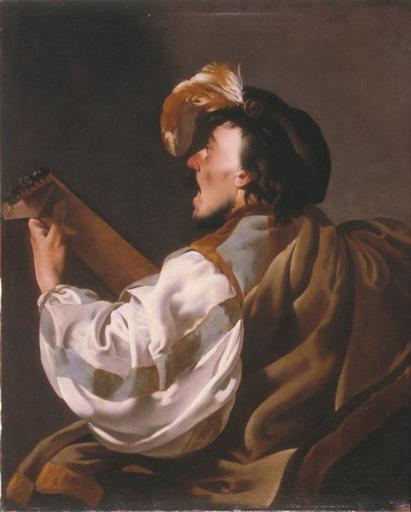
One of the world’s finest musicians, who played the lute to perfection, in a brief time became so extremely deaf that he completely lost the use of his hearing.  However, in spite of that he did not give up singing and playing the lute, doing so with marvelous delicacy by reason of his great skill which his deafness had not taken away.  he had no pleasure either in singing or in the sound of the lute, since after his loss of hearing he could not perceive their sweetness and beauty.  Hence he no longer sang or played except to entertain a prince whose native subject he was and whom he had a great inclination as well as an infinite obligation to please since he had been brought up from his youth in the prince’s court.  For this reason he had the very greatest pleasure in pleasing the prince and he was overjoyed when the prince showed that he enjoyed his music.  Sometimes it happened that to test this loving musician’s love, the prince would command him to sing and immediately leave him there in the room and go out hunting.  The singer’s desire to fulfill his master’s wishes made him continue his song just as attentively as if the prince were present, although in fact he himself took no pleasure out of singing.  He had neither pleasure in the melody, for his deafness deprived him of that, nor that of pleasing the prince, since the prince was absent and hence could not enjoy the sweetness of the beautiful airs he sang. (On the Love of God, Book 9, Chapter 9)