Infinite calm

I love to know and read people who really know the essence of life.  They feed my soul.  Dom Augustin Guillerand is one of these.  His words are worth chewing on:

“This is the secret of peace, after committing a fault.  What is past is past.  And if we accept the consequences, while bracing our will, we can be sure that God will know how to draw glory even from our faults.  Not to be downcast after committing a fault is one of the marks of true sanctity, for the saint knows how to find God in everything, in spite of human appearances.  Once your will is sincerely “good,’ then don’t worry . . .

“In all that we do, and at every moment, God has ordained an exact balance between what we have to do and the necessary strength to do it; and this we call grace.  Our part is to bring ourselves into line with grace.

“God uses all the horrors of this world for an infinitely perfect end, and always with an infinite calm.  It is part of his plan that we should feel the blows and experience the wounds of life; but more than anything else he wants us to dominate them by virtues of faith, hope, and charity, and so live on his level.  It is these latter which will raise us up to him, and then we shall share in his calm, and in the highest part of our being.”   (Dom Augustin Guillerand, O.Cart.)

A kind twist

It’s time for Amy Carmichael:

“Sir Robert Ball, the astronomer, began when he was old to write the story of his life.  He made this rule for himself: ‘Try to give everything narrated a kind twist.'”

How would our lives look to us if we practiced doing that?

She goes on to say:

“Isn’t that such a beautiful rule?  Let us ask the Spirit of God to search us about this matter of giving a ‘kind twist’ to what others say and do.”

Pray for me, and I’ll pray for you.

Who was transfigured?

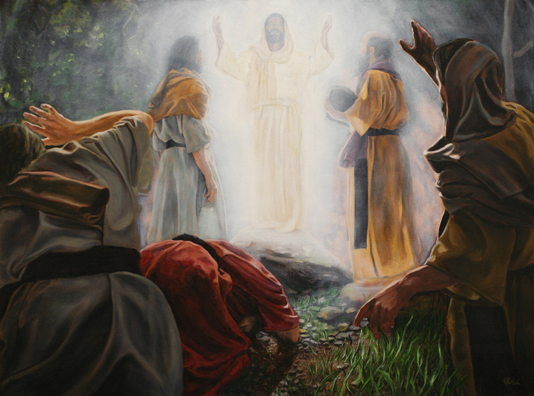
When one thinks of the Transfiguration one usually thinks of Christ being transfigured–almost like Christ turning on a light bulb.  But there is a valid line of thinking in the Eastern Church that goes like this: “In a certain way it was really the apostles who were transfigured; it was they who became able to see.”  It wasn’t so much Christ whose glory changed; the apostles were just allowed to see Him as He truly is.  Christ opened their eyes so that they could see Him in all His glory.

And that’s the point of the Christian life, to have our eyes opened to the Mystery of God.  To constantly surrender ourselves to His grace, that the eyes of our hearts may be transfigured and more and more able to perceive the beauty and glory of our God.


Dust and Flame

A Sunday-poem by Amy Carmichael:

Dust and Flame

But I have seen a fiery flame
Take to his pure and burning heart
Mere dust of earth, to it impart
His virtue, till that dust became
Transparent loveliness of flame.

O Fire of God, Thou fervent Flame,
Thy dust of earth in Thee would fall,
And so be lost beyond recall,
Transformed by Thee, its very name
Forgotten in Thine own, O Flame.

Have a blessed Sunday.  May you come to know how much your own life has truly been transformed into His.

Little prayers

I just wanted to remind you that I have started a new blog: Heart Arrows, little prayers that pierce the Heart of God.  Its purpose is to provide a short prayer each day that you can pray all throughout the day.  The name of the blog comes from the way that monks spoke of ejaculations–as arrows sent off to God.  If the particular prayer for the day doesn’t strike you, you can still pray it as a form of intercession for someone (perhaps unknown to you) who may need the benefit of that prayer.

You will find only one post displayed each day.  That is purposeful–to keep our prayer very, very simple and focused.

Some ideas on how to use this blog: write the prayer for the day on an index card and put it up over your kitchen sink; stick it on your dashboard; memorize it and pray it on the hour.  Please share on the blog any creative ideas you may have.

Praying that this will be a help to many of you . . . to send those tiny arrows off to pierce the Heart of God all day long.

“At times it seems I am getting worse”

The beginning of the second chapter of Fr. Tadeusz Dajczer’s book, Amazing Nearness:

I get so disheartened.  I am frequently in touch with the Lord, yet I am always falling away from Him.  I am always falling in the same old way.  At times it seems I am getting worse.  Furthermore, it is He who is inviting me to follow and unite with Him.  I am not starting it. He is.  He is the way; He is lighting the way.  He is the grace that leads me on.  I know so little about this because He doesn’t want me to know His mysterious operations within me.

I ask how I can avoid getting so disheartened.  Yet it is success that should really surprise me.  I have to remember that the Lord only enters my heart through the failures that cause my spiritual emptiness.  That is where faith comes in.  He wants me to be inundated with problems so He can stay with me.  Then I will want Him more and more.

I need to be patient with myself.  He doesn’t get disheartened with me, so why should I get so upset?  He loves me just as I am.

Fr. Dajczer, of course, is not condoning complacency here.  We need to, of course, be quick to repent and try to change.  But he recognizes that even as we try so hard, there are many times when we still fall.  These are the times he is speaking about:

It is often hard for me to be forbearing [with myself], as I want everything immediately so that I am better than others.  Yet God is not in a hurry.  I am the hasty one with an interior hubbub.  This impedes my spiritual progress.  My impatience may look like zeal or even righteous indignation.  I forget that this can be self-love or greed.

The answer, as always, is full surrender to Him, to His time and His plan.  To be patient with ourselves and with Him.  ” He wants me to be inundated with problems so He can stay with me.  Then I will want Him more and more.”