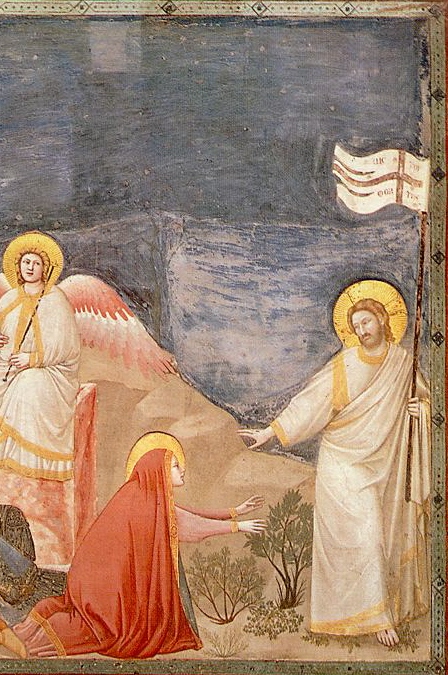
I must confess that I have always been bothered by Christ’s words to Mary Magdalene at the tomb, telling her to not hold on to him. I’ve read many commentaries on that passage but still find my heart protesting. How can you ask her–how can you ask me–to not hold on to you? But then I came across this:
“Yes, by all means, hold on to him! Grasp his cloak or grasp his legs, or throw your arms around his body and hold him tight! But you must do this in the right way, for he cannot be held by merely human arms. Rather, it is the love of your heart which alone can hold him, the faith and hope that impel you to surrender yourself trustingly into his embrace. You can hold him when you let yourself first be held.” (Joshua Elner)
I found this prayer somewhere–sorry, I have no memory of where–and since then we have prayed it together in our community every Holy Saturday morning.
Lord Jesus Christ, in the darkness of death; in the abyss of the deepest loneliness abides now and always the powerful protection of Your Love; in the midst of Your hiding we can by now sing the Hallelujah of the saved. Grant us the humble simplicity of faith, which will not be swerved when You call us in the hours of darkness and abandonment, when everything seems difficult: grant us, in this time when a mortal battle is being fought all around You, enough light not to lose sight of You; enough light that we can give it also to those still in need of it. Let the mystery of Your Easter joy shine like the light of dawn on our days; grant us that we may be truly men and women of Easter in the midst of the Holy Saturday of history. Grant us that through the bright and dark days of these times we may always with a light heart find ourselves on the path towards Your future glory. Amen.
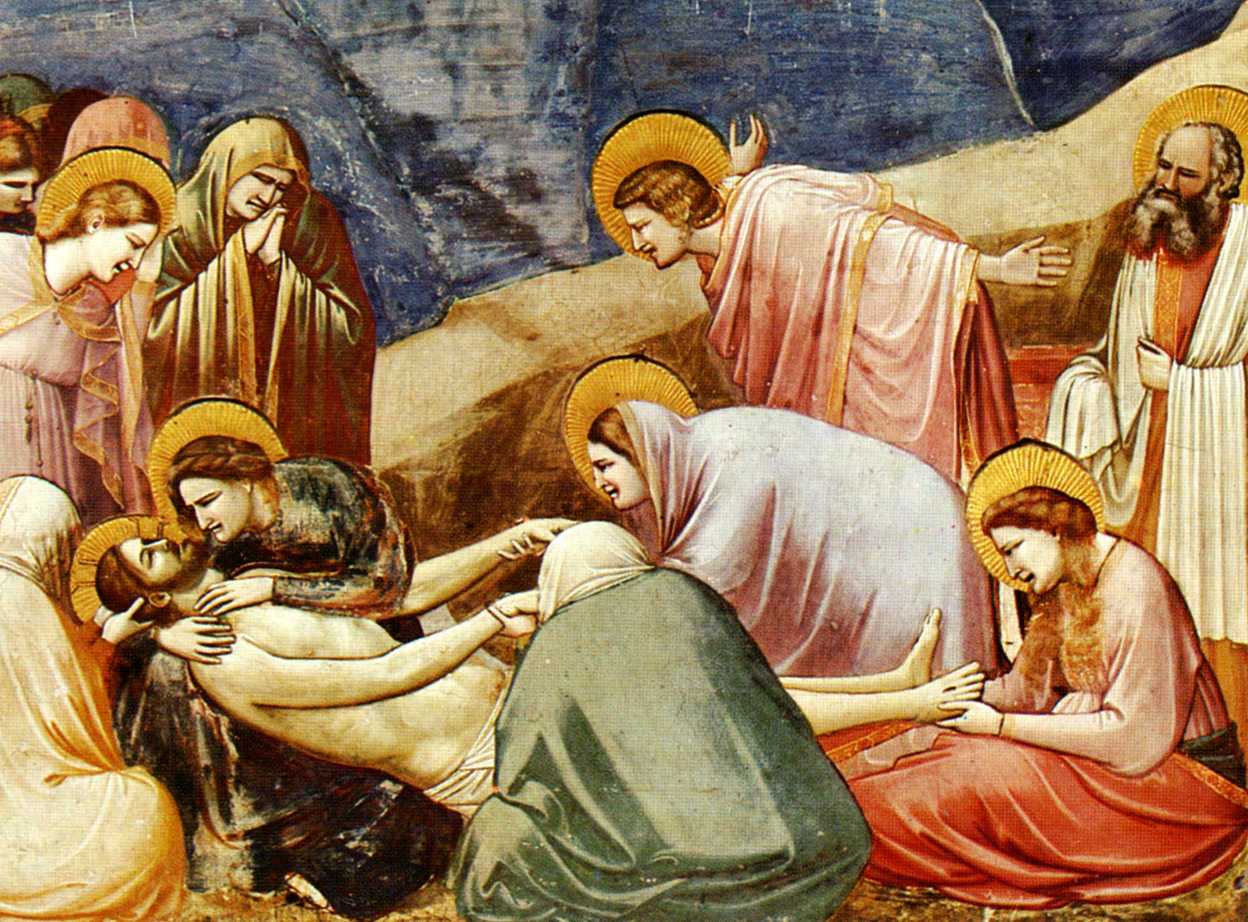
I want to share one more thing this Good Friday from almost twenty years ago when I was meditating on this painting by Giotto.
As I prayed with this image, I placed myself at the feet of Jesus, my heart so deeply desiring to venerate his most sacred feet, even in his death, but feeling so extremely unworthy. This is the prayer that I then prayed:
“I will kiss your feet while your Mother kisses your Holy Face–and You will be so wholly taken by her kisses that you will mistake mine for hers and be so perfectly comforted in your Passion that you will not notice those of your betrayers . . . Jesus, I offer you her sweet kisses. Be taken by them. In the company of the myriad of those who kiss your hands, your handmaids who have gone before me, those you have lifted up by your favor. We will cover you with kisses . . . Who am I that I even dare to touch your sacred feet with my sullied lips? Yet I give you my poor little kisses; your sacred flesh will purify them as does a hot burning coal (cf. I 6:6-7)”
Addendum: In the years since then, the Lord has shown me clearly how much he values my kisses. And, to be sure, yours as well.
There’s always hope. We just need to weep and wait for him.
Judas, Peter
because we are all betrayers, taking silver and eating body and blood and asking (guilty) is it I and hearing him say yes it would be simple for us all to rush out and hang ourselves but if we find grace to weep and wait after the voice of morning has crowed in our ears clearly enough to break our hearts he will be there to ask us each again do you love me
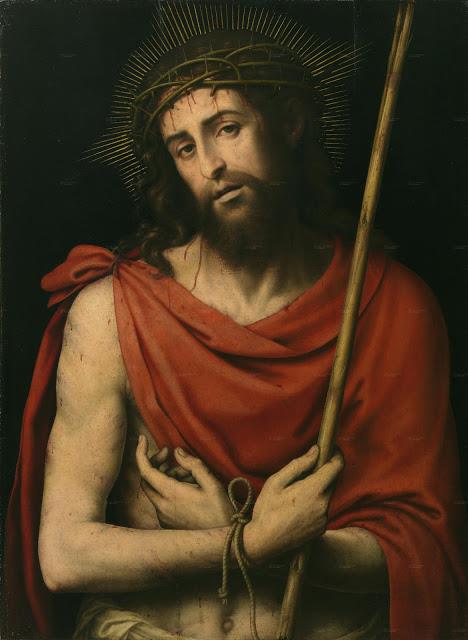
“He who is more fair than all the sons of men offered his fair face to be spat upon by sinful men; he allowed those eyes that rule the universe to be blind-folded by wicked men; he bared his back to the scourges; he submitted that head which strikes terror in principalities and powers to the sharpness of the thorns; he gave himself up to be mocked and reviled, and at the end endured the cross, the nails, the lance, the gall, the vinegar, remaining always gentle, meek and full of peace.” (From The Mirror of Love by St. Aelred)
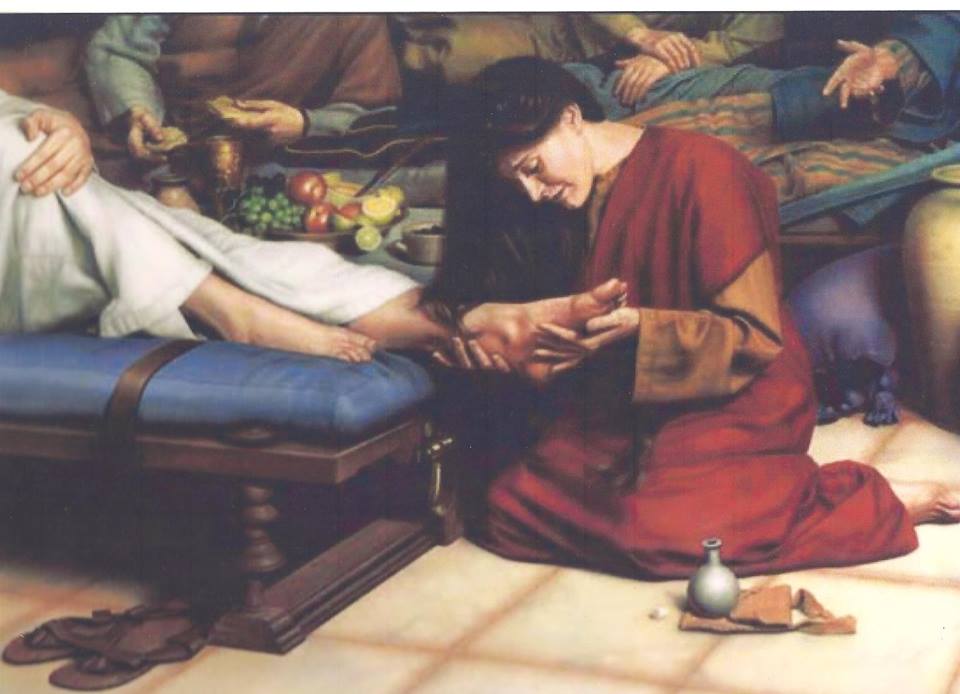
While the King rests in his own room, my nard yields its perfume. (Song of Songs 1:12)
Simon Dewey
“In the gospels, Mary, the sister of Martha and Lazarus, poured out a costly nard ointment that symbolized both her complete devotion to Christ and the anointing of Christ for his death and burial (Jn 12:3; Mk 14:3; Mt 26:6-13). Here is accentuated the costliness of the nard, which is poured out and fills the entire house with its perfume. Such a perfume brings a great price. To anoint Christ as your king will demand from you a constant sacrifice of everything in order that you can become a precious perfume to him.”
A Sunday poem for the beginning of this Holy Week.
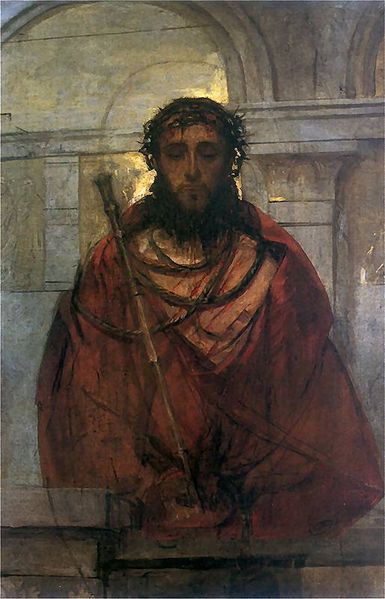
Adam Chmielowski
Royalty
He was a plain man and learned no Latin. Having left all gold behind he dealt out peace to all us wild ones and the weather. He ate fish, bread, country wine and God’s will. He wore purple only once and that was an irony.
Jan’s book, Circle of Grace, must be one of my favorite books of poetry. This Sunday poem is from another of her books, The Cure for Sorrow: A Book of Blessings for the Seasons.
THE HARDEST BLESSING
If we cannot
lay aside the wound,
then let us say
it will not always
bind us.
Let us say
the damage
will not eternally
determine our path.
Let us say
the line of our life
will not always travel
along the places
we are torn.
Let us say
that forgiveness
can take some practice,
can take some patience,
can take a long
and struggling time.
Let us say
that to offer
the hardest blessing,
we will need
the deepest grace;
that to forgive
the sharpest pain,
we will need
the fiercest love;
that to release
the ancient ache,
we will need
new strength
for every day.
Let us say
the wound
will not be
our final home—
that through it
runs a road,
a way we would not
have chosen
but on which
we will finally see
forgiveness,
so long practiced,
coming toward us,
shining with the joy
so well deserved.
—Jan Richardson
from The Cure for Sorrow: A Book of Blessings for the Seasons
It’s been a bit of a rough week for me. This week is bookended by the anniversaries of two of my brothers’ passings, one who died just a year ago and the other many years ago from suicide. Also, another brother (closest to me in age) is currently homeless.
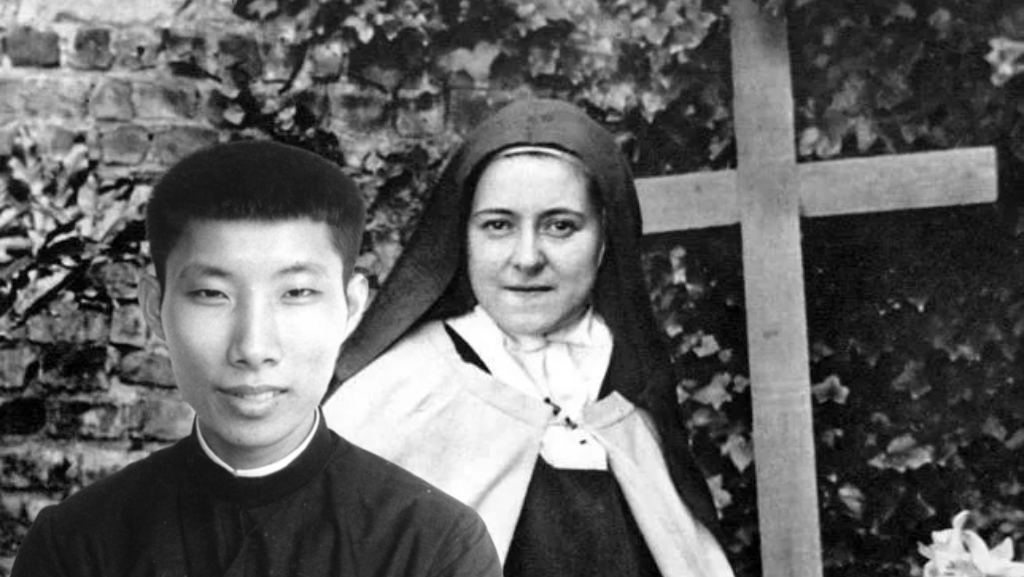
Not too long ago, after having read so much about him at Benjamin Embley’s blog, Contemplative in the Mud, I read Marcel Văn’s Autobiography. Văn had an incredible relationship with St. Thérèse who appeared to him and spoke with him often. I’ve been going back again and again to something she first said to him:
“If on the other hand, you are invaded by sadness, say to him again with an open heart: ‘O my God, I am really unhappy!’ And ask him to help you to accept this sadness with patience. Really believe this: nothing gives as much pleasure to the good God than to see on this earth a heart which loves him, who is sincere with him with each step, with each smile, as well with tears as with little momentary pleasures.”
“So when you speak to the good God, do so quite naturally as if you were talking to those around you. You can speak to him of anything you wish: of your game of marbles . . . God takes pleasure in listening to you; in fact, he thirsts to hear these little stories which people are too sparing with him.”
This has been the form of my prayer this week, a little child bringing all to her Father because that is the kind of Father that he is.

 Witnesses to Hope