If any of you would like to see John Anderson’s wonderful photos of Sr. Katie’s Profession Mass this past Saturday, you can click here.
“Nothing is lost in Him.”
“The personal history of each one of us is precious to him. . . . Nothing is lost in him.” (Maria Boulding)
I’m still thinking about that 20 minute movie I recommended yesterday. (I had a chance to watch it again last night with Sr. Sarah.) This extract from a book by Maria Boulding is another attempt at expressing the point of the movie:
The personal history of each one of us is precious to him. He is more willing to forgive our sins than we are to ask forgiveness, and he is well able to redeem our deficiencies too. We shall not spend eternity kicking ourselves for opportunities lost, grace wasted and love refused. How he can make these things good is beyond our understanding, but in some way the whole of it will be taken up into Christ. Some lines scribbled in the margin of a fourteenth-century manuscript convey an unknown scribe’s insight into this mystery:
He abideth patiently,
he understandeth mercifully,
he forgiveth easily,
he forgetteth utterly.
All the positive things will be taken up into Christ, to be saved in all their reality and transfigured in him: the love that we have given and received, the moments of aching beauty, the longing and the pain, the laughter and surprise, the plain plodding on . . . . Nothing is lost in him. All the great loves, all the heroism, all the struggle to make life more human, all the wrong turnings people have taken in their search, the times when a light more than human seemed for a while to play over human lives and those lives became legend, the poetry of the particular, the unrepeatable beauty, the fidelity to a vision that demanded all. In Christ all these things will be affirmed and redeemed, to become part of our shared joy, and his. (Maria Boulding, The Coming of God, p. 161)
The Butterfly Circus
One of the sisters called my attention to this beautiful short film, that you can view here: The Butterfly Circus. I’d love to read your comments.
A message of the movie is this:
No one has been born by chance and no one was consulted before being brought into the world. The essence and existence of each person is something of extraordinary value, something very important . . . And if no one exists by chance, there is no chance involved in his particular physical and psychological make-up. There is also a reason for the fact that everyone has his own individual temperament, qualities, a particular degree of intelligence, sensitivity and even particular features . . . Everything has a reason for being and existing and each creature has been appropriately gifted for the end which it is to fulfill in the universe. (Frederico Suarez, Mary of Nazareth)
The lady of fair weeping
Mary is beautiful, even in her sorrow.
Today is the Feast of the Sorrowful Mother. Recalling Cardinal Ratzinger’s words from yesterday’s post, we can see that Mary is beautiful even in her sorrow:
The Blessed Virgin is the lady of fair weeping. Her tears were beautiful. These are the sorrows of one who is all beautiful, full free from the deformity of sin. . . No lamentation has been lovelier, no compassion purer . . . . The sinless Spirit-filled heart of Mary is beautifully centred on the will of the Father and on His and her Son and those for whom He suffers. (John Saward, The Beauty of Holiness and the Holiness of Beauty)
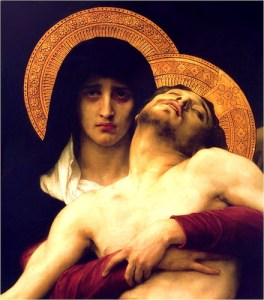
And a little consoling excerpt from Magnificat today: “As the Savior’s dying gift to us, Jesus leads us back to Mary. For we need the maternal closeness of the Sorrowful Mother to sustain us when overcome by the terrifying trials of life.”
“The arrow of His paradoxical beauty”
Today is one of our community feasts, the Triumph of the Cross. Many things could be said about this day, but what is coming to mind–since I’ve been thinking about beauty so much these days–is another excerpt from the then Cardinal Ratzinger’s address to the Communion and Liberation community in Rimini. He started his address by speaking about how on the Monday of Holy Week the Liturgy of the Hours juxtaposes two seemingly contradictory antipons: You are the fairest of the children of men and grace is poured upon your lips (Ps 45.3)and He had neither beauty, no majest, nothing to attract our eyes, no grace to make us delight in him (Is 53.2). He says, “How can we reconcile this?” and then goes on to talk about true beauty: a love that loves “to the end” (Jn 13.1).
The One who is the Beauty itself let himself be slapped in the face, spat upon, crowned with thorns; the Shroud of Turin can help us imagine this in a realistic way. However, in his Face that is so disfigured, there appears the genuine, extreme beauty: the beauty of love that goes “to the very end” . . . Is there anyone who does not konw Dostoyevsky’s often quoted sentence, “The Beautiful will save us”? However, people usually forget that Dostoyevsky is referring here to the redeeming Beauty of Christ. We must learn to see Him. If we know Him, not only in words, but if we are struck by the arrow of His paradoxical beauty, then we will truly know Him, and know Him not only because we have heard others speak about Him. Then we will have found the beauty of Truth . . .
You can find his entire address here and it is worth reading in its entirety.
And let us let ourselves be wounded by the arrow of Christ’s paradoxical beauty. . .
Invitatory for a Wedding Anniversary
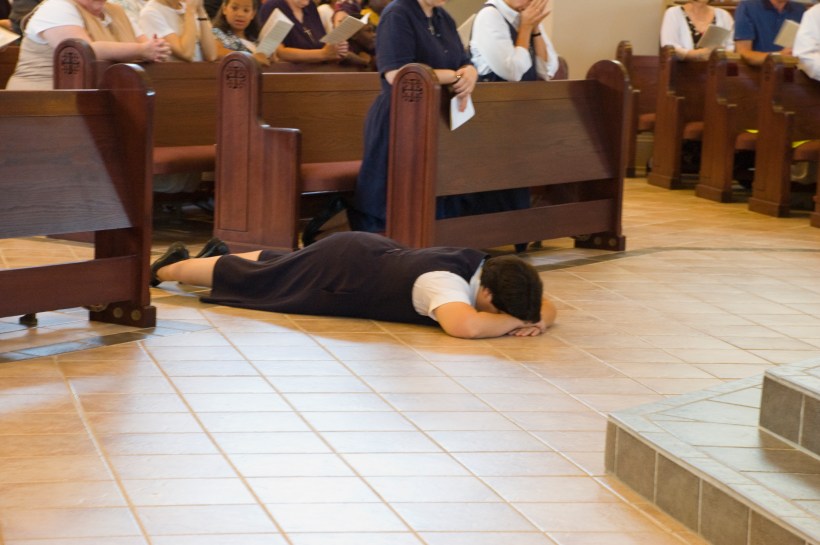
Yesterday one of our sisters, Sr. Katie, made her Final Profession of Vows. It was a wonderful day for all of us. Today another sister, Sr. Christina, is celebrating her first anniversary of Final Vows, and tomorrow on one of our major feasts, the Triumph of the Cross, three other sisters are celebrating anniversaries. This poem, by Mother Mary Francis, seems so appropriate:
Invitatory for a Wedding Anniversary
“We recount your marvelous deeds” (Psalm 75)
Come, let us marvel at God confecting dawn
Out of a pastelled fluff of fancy, then
Unbfolding night from velvet bolt of mystery, arranging
Moons halved, then quartered, then plumped full
To serve our recreation.
But marvel more that He has brided me.
Here is tall marvel: twirled by hand Divine
All birds’ propellers dancing circled grace
Down boulevarded space and all trees waving
For such performance, fans of jubilation.
Sun stoked and skies spread and clouds lit
With virgin light or pregnant with the rain
Are marvels that demand high recounting.
But marvel more that He has brided me.
Come, let us kneel before th Lord devising
Day from the night and marshalling the stars,
Flattering peaches pink, and then gone off surprising
Carrots to gold with glance Divine
And us to exaltation.
But marvel more that He has brided me.
All the long aeons God has lightly laid
Across our history call: Marvel! and
We gladly tell it, call for cosmic chorus to proclaim it:
God great, God mighty, God beyond
Our power small to marvel.
But marvel more that He has brided me.
The way to men’s souls is through their hearts
Beauty can can come to us in so many varied ways. Through story and song, as described in this excerpt from Stephen Lawhead’s Merlin:
And it came to me while I was singing–watching the ring of faces around the night’s fire, their eyes glinting like dark sparks, gazing raptly as the song kindled and took light in their souls–it came to me that the way to men’s souls was through their hearts, not through their minds. As much as a man might be convinced in his mind, as long as his heart remained unchanged, all persuasion would fail. The surest way to the heart is through song and story: a single tale of high and noble deeds spoke to men more forcefully than all of blessed Dafydd’s homilies.
Beauty can come to us through a beautifully written book or poem. I re-read certain books periodically, like Cry, the Beloved Country, just for the beauty of the story and of its writing.
Or through the life of a lover of souls. John Paul II.
All true beauty reflects the pure and stunning beauty of God, and, of course, I have only mentioned a few avenues of encountering it. How have you perceived His beauty?
The impact on our hearts
“The encounter with the beautiful can become the wound of the arrow that strikes the heart . . .” (Ratzinger)
I feel a need to talk about beauty. Some of you have heard me speak about this, and it is still very much on my heart. I continue to be struck by its lack in our culture and society with the predominant emphasis on technology and efficiency. So I think my next few posts will be an attempt to remind us of the importance of beauty in our lives. All true beauty reflects the beauty of God and draws us to Him.
The encounter with the beautiful can become the wound of the arrow that strikes the heart and in this way opens our eyes, so that later, from this experience, we take the criteria for judgement and can correctly evaluate the arguments. For me an unforgettable experience was the Bach concert that Leonard Bernstein conducted in Munich after the sudden death of Karl Richter. I was sitting next to the Lutheran Bishop Hanselmann. When the last note of one of the great Thomas-Kantor-Cantatas triumphantly faded away, we looked at each other spontaneously and right then we said: “Anyone who has heard this, knows that the faith is true.” The music had such an extraordinary force of reality that we realized, no longer by deduction, but by the impact on our hearts, that it could not have originated from nothingness, but could only have come to be through the power of the Truth that became real in the composer’s inspiration. (emphasis added)
(Cardinal Ratzinger, Message to the Communion and Liberation meeting at Rimini, 2002)
In another place, Cardinal Ratzinger said:
The only really effective apologia for Christianity comes down to two arguments, namely the saintsthe Church has produced and the art which has grown in her womb. Better witness is borne to the Lord by the splendour of holiness and art which have arisen in the community of believers than by the clever excuses which apologetics has come up with to justify the dark sides which, sadly, are so frequent in the Church’s human history. If the Church is to continue to transform and humanize the world, how can she dispense with beauty in her liturgies, that beauty which is so closely linked with love and with the radiance of the Resurrection? No. Christians must not be too easily satisfied. They must make their Church into a place where beauty–is at home. Without this the world will become the first circle of Hell. (quoted in John Saward, The Beauty of Holiness and the Holiness of Beauty, San Francisco: Ignatius Press, 1997)
How can we bring more beauty into our lives? Are there ways that we are letting efficiency and technology dominate? I know for myself, I can feel guilty sometimes for taking time to peruse something beautiful, say, a poem or a piece of art–that I’m wasting time (!). But I also wonder if there are not more ways to just bring beauty into our daily life. I think doing so will give us more hope.
“Davey’s Song”
A Professor of English writes about the “divine music” of his autistic son.
This article by Anthony Esolen (Professor of English at Touchstone College and senior editor of Touchstone magazine) has been on my mind. He wrote it a few years ago about his relationship with is son, Davey, who is autistic. It is subtitled “Anthony Esolen on the Divine Music of an Autistic Son”. I encourage you to read it (and anything else by him as well): “Davey’s Song.”
Nativity of Mary
A short hymn in honor of the Feast of the Nativity of Mary, the Theotokos.
Just a short hymn from the Eastern Church in honor of this day.
Kontakion (Tone 3)
- Today the Virgin Theotokos Mary
- The bridal chamber of the Heavenly Bridegroom
- By the will of God is born of a barren woman,
- Being prepared as the chariot of God the Word.


